
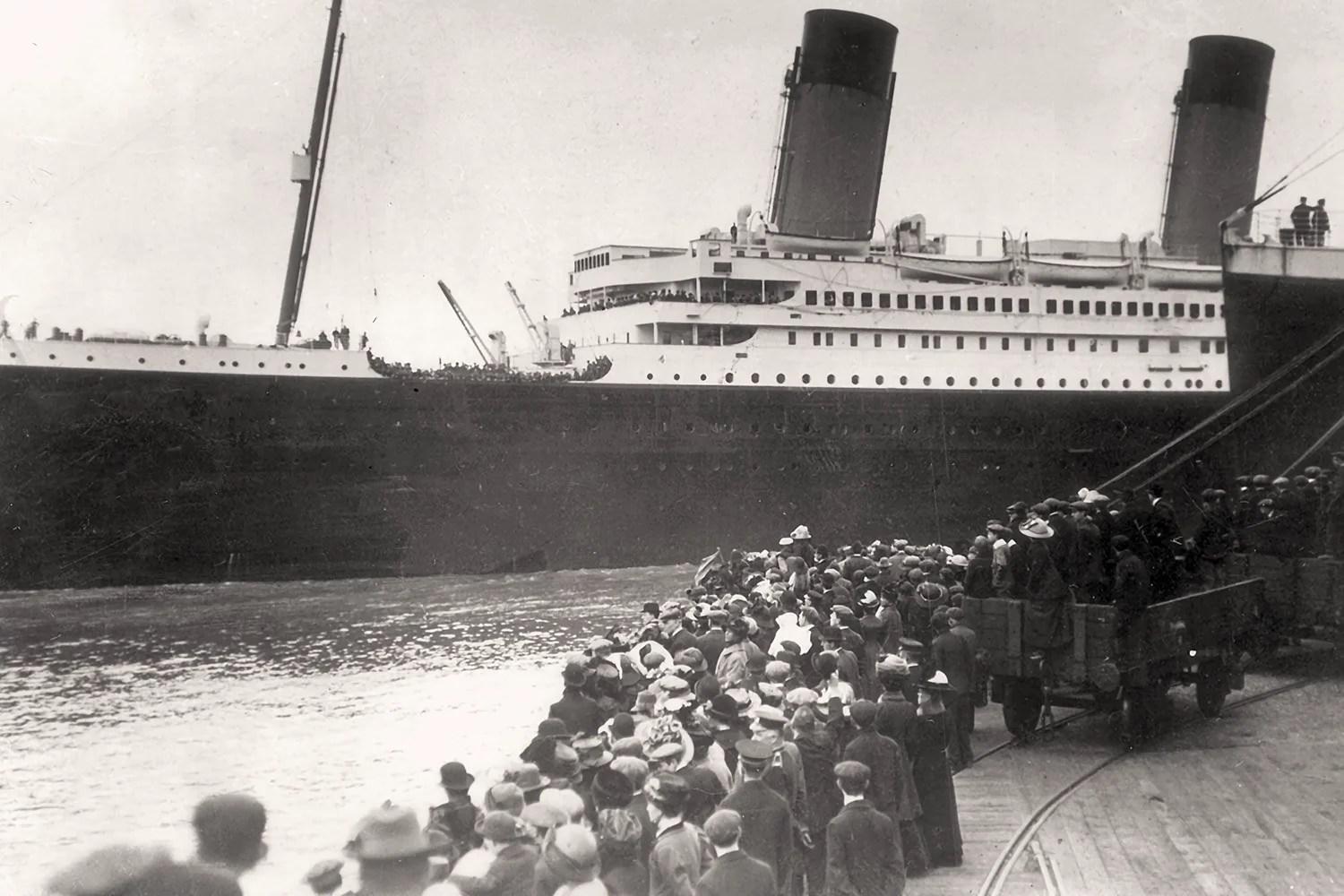
Harland and Wolff built Titanic in Belfast for the White Star Line to carry passengers, cargo, and mail across the Atlantic. On her first voyage to New York in April 1912, an iceberg opened several forward compartments to the sea. The bow sank low enough for water to spill over the walls between them. About 700 people survived and roughly 1,500 died. The loss helped change lifeboat and radio rules worldwide. In 1985, a French-American expedition found the wreck more than two miles deep off Newfoundland.15811151921
Why did White Star want three ships this big?
Before airlines crossed the Atlantic, a family moving from Europe to North America had to book passage by sea. So did a traveler on business who expected to come home a few weeks later. The same liner could take both passengers, along with sacks of mail and a hold full of cargo. For the White Star Line, the question was how to draw a crowd to the dock week after week.128
In 1907, J. Bruce Ismay of the White Star Line and William Pirrie of the Belfast shipbuilder Harland & Wolff were planning a new generation of liners. Cunard and the German lines were formidable rivals. White Star’s answer was a fleet of three exceptionally large, comfortable ships on the Southampton–New York route. A wider hull made room for more passengers and cargo on each trip. With several ships, one could be taking on passengers while another was at sea. Olympic came first, Titanic second, and Britannic was to follow. The company expected years of crossings from each of them.122031
First class got much of the attention. The passenger list tells a different part of the business story. On Titanic’s Atlantic crossing, third-class passengers outnumbered first and second class combined. The Harts, a family emigrating to Winnipeg, traveled in second class. They had booked first class on another liner. When a coal strike disrupted sailings, the company transferred them to second class on Titanic.5715
What did it take to build yard number 401?
In Belfast the job began by making room. Harland & Wolff combined three building slips into two wider ones, with a tall steel framework overhead so workers could lift material into place. On March 31, 1909, they laid Titanic’s keel, the backbone along the bottom of the hull. Olympic was already rising beside it. In the yard the two ships were numbers 400 and 401.23
From that backbone grew a hull nearly 270 metres long, about 880 feet. Workers joined its steel plates with roughly three million rivets. Inside, coal fires heated water in 29 boilers. Steam powered two piston engines and a turbine, which together drove three propellers. Every crossing would depend on people below deck moving coal, tending the fires and keeping that machinery running.31529
On May 31, 1911, spectators watched Titanic’s hull slide into the water. A handwritten shipyard record gives her next destination as a wharf in Belfast. Nearly eleven months of work separated that launch from the first passenger voyage. In Belfast, crews still had engines, propellers, cabins and countless fittings to get ready. Olympic began carrying passengers that June, while Titanic was still in the yard. When spray made the front of Olympic’s promenade deck slippery, the builders put windows around that stretch of deck on Titanic.1234
On April 2, 1912, Titanic completed her sea trials and White Star took possession. She left Belfast for Southampton, England. Among those who went aboard for the first voyage was Thomas Andrews, who had overseen her construction. He went through the ship with her officers, inspecting details that included the watertight doors.212
Where was Titanic going, and who went with her?
Captain Edward Smith took Titanic out of Southampton on April 10, 1912, bound for New York. Almost at once there was a near collision. As Titanic passed a moored liner named New York, the movement of water pulled at the other ship hard enough to break its mooring lines. A tug helped pull it clear. Titanic resumed her voyage about an hour behind schedule.25
That evening at Cherbourg, France, the harbor could not accommodate the liner at the quay. Passengers crossed the last stretch in smaller vessels called tenders. Nomadic carried first- and second-class travelers. Traffic carried third-class travelers and baggage. On April 11 came Queenstown in Ireland, now called Cobh, where more passengers came out to join the ship. Others went ashore. One was Francis Browne, who took his photographs of life aboard with him. That is how some pictures of a crossing that never reached New York came down to us.627
Roughly 2,200 passengers and crew headed west. The letters RMS before Titanic’s name meant Royal Mail Ship. While passengers found their cabins, five British and American postal clerks had a sea-going post office to run. They sorted letters on the crossing so that, once ashore, the bundles could go straight on toward their destinations. A clerk named Oscar Scott Woody stamped his own name on the slips that went on top. If a bundle went astray, the service could trace who had sorted it.58
What was an ordinary day like on board?
Suppose you asked a passenger what time dinner was. On Titanic, you needed to know which ticket they had bought. Third class ate its main meal at midday. On Sunday, April 14, the menu offered rice soup, roast beef with gravy, boiled potatoes, and plum pudding. The menu card doubled as a postcard. Second class ate dinner in the evening. That night a passenger could choose curried chicken with rice or spring lamb with mint sauce, then have ice cream.7
First-class travelers could eat in their dining saloon or pay extra to dine in a restaurant with its own reception room. Even the table settings recorded the distinctions aboard. First- and second-class napkin rings shared a design, but the second-class silver carried a little cross. Third-class passengers got printed paper napkins. Walk through the kitchen door and two of those worlds met again. The cooks preparing first- and second-class meals worked in the same kitchen department, between the two dining rooms.7
Second-class passenger Lawrence Beesley, a teacher, had explored the ship at Southampton with two friends who came to see him off. They found the gymnasium on the boat deck and tried the exercise bicycles. When two photographers arrived, the instructor asked the visitors to stay where they were. Beesley thought the men wanted a picture of the equipment in use. Only later did he learn the photographs were for a London paper.2331
Much of the ship’s daily work left little trace in passenger photographs. A steward had cabins to attend to and meals to serve. Stokers fed the furnaces. The wireless operators could exchange messages with ships beyond sight. On that Sunday, other ships used wireless to report ice ahead. The information reaching the bridge would matter long before most people aboard had any reason to think about ice.25915
How did an iceberg get so close?
By the evening of April 14, Captain Smith and his officers knew that ships had reported ice in the region they were entering. The lookouts were told to watch for it. Titanic kept up about 22 knots, roughly 25 miles an hour. British investigators later judged that speed excessive for the conditions. A wireless warning told the officers where to expect ice. On a clear, calm night, the lookouts still had to pick out an individual iceberg in the dark, with enough room left to turn a ship almost 900 feet long.291034
At about 11:40 p.m., a lookout struck the warning bell three times and telephoned the bridge. First Officer William Murdoch ordered a turn. The bow had begun to swing left when the iceberg caught the forward starboard side, the right side as you face the front. The impact opened the hull to the sea below the waterline in several places. Murdoch also operated the control for the watertight doors below.910
Third-class passenger Daniel Buckley later told the U.S. Senate what the collision felt like down in his cabin. After hearing a noise, he got out of bed and found his feet getting wet. His cabin mates laughed when he first urged them to get up. People in different parts of the same ship had very different clues about what had just happened.13
Why couldn’t the watertight doors save the ship?
Fifteen walls crossed the lower hull, dividing it into sixteen large compartments. A shipbuilder calls one of those walls a bulkhead. Shut a door through a bulkhead and water on one side cannot pour through the doorway. This gave Titanic real protection. The British inquiry found she could have stayed afloat even if the first four compartments at the bow, the front of the ship, had flooded.1112
Now follow the water one compartment farther back. The iceberg had also opened the foremost boiler room to the sea. With those five spaces filling together, the weight of water pulled the bow deeper. The bulkheads rose above the ship’s normal waterline, but several ended partway up the ship. As the bow tipped down, the top of the wall behind the flooding boiler room came low enough for water to spill over it into the next boiler room.1112
Investigators found a smaller leak in that next boiler room, too. But even with its outer hull intact and its door shut, water spilling over the wall would have filled it. As it filled, the bow sank lower and water reached the top of the next wall. The pumps could remove some water, but seawater was coming in much faster than they could take it out. Afterward, second-class survivor Lawrence Beesley recalled the confidence people had placed in the ship’s safety. The builders’ figures show just how much depended on where the iceberg struck. Four flooded spaces at the bow left enough of the ship above water. The fifth gave the sea a path into the rest.111231
Who could reach a lifeboat?
The crew roused passengers, issued lifebelts and began lowering boats. Titanic carried twenty boats, including four with collapsible sides. By the British inquiry’s calculation, they held 1,178 people altogether. Even if every place had been filled, more than a thousand people aboard that night would still have needed a way off. The ship actually exceeded Britain’s legal minimum. The rule used a table based on a ship’s tonnage, a measure of its enclosed volume. Its top bracket began at 10,000 gross tons. The table put Titanic, at more than 46,000 gross tons, in that same bracket.9141530
At least eight boats left with room to spare, the British inquiry found. Early on, some passengers hesitated to leave the liner. Some officers doubted a boat could take its full load while hanging from its lowering gear. Others expected to pick up more people through doors farther down the ship’s side. A place in the official capacity was useful only if a passenger reached the right deck while that boat was still there.930
Buckley reached the deck, saw other people wearing lifebelts and turned back for his. Water was already several steps up the last staircase to his cabin. He climbed back up. On deck, a first-class passenger who had two belts gave him one and fastened it for him. Buckley helped with the ropes and eventually got into a boat.13
Women and children generally had priority. Where a passenger started also mattered. The British inquiry cited the location of the different classes’ quarters among the reasons their chances differed. Its figures show that about 62 percent of first-class passengers survived, 41 percent of second class, and 25 percent of third class. About 24 percent of the crew survived. Those are the proportions within each group. Buckley’s account gives us one person’s route through a ship in which hundreds of others never reached safety.91525
What could another ship do in time?
Titanic’s wireless operators, Jack Phillips and Harold Bride, sent calls for help. On the liner Carpathia, Captain Arthur Rostron ordered his ship turned toward Titanic. He posted extra lookouts for ice. While the two ships were still miles apart, he had doctors stationed in dining rooms and his crew rigging ladders and slings. He even ordered canvas bags ready for lifting children from boats alongside. Another ship, Californian, was nearer, but her sole wireless operator had gone off duty. Nobody there heard the first distress call.21626
At about 2:20 a.m. by the ship’s clock on April 15, two hours and forty minutes after the collision, Titanic disappeared beneath the North Atlantic southeast of Newfoundland. People who went into the bitterly cold sea had little time. A lifebelt could keep a person’s head above water. It offered little shelter from the cold while Carpathia was still making her way through ice.910262830
Carpathia reached the area around four in the morning. The first boat came alongside at about 4:10, and the last survivors were aboard by about 8:30. Rostron then took them to New York. The British and American inquiries counted the people aboard and the survivors slightly differently. Both records give much the same scale of loss. About 700 people lived and roughly 1,500 died.51516
What happened to the families waiting ashore?
On April 18, Carpathia brought the survivors into New York. More than two hundred of them were members of Titanic’s crew. The Seamen’s Church Institute helped provide fresh outfits for the surviving stewardesses, and boots, caps, razors and combs for the men. The crew gathered for refreshments and a service for the people they had worked alongside only days before.1632
Farther up the Atlantic coast in Halifax, Nova Scotia, a different operation had already begun. The port was home to cable ships whose crews knew how to work in North Atlantic ice and rough seas. White Star asked them to search for the dead. The first, Mackay-Bennett, sailed on April 17 with a chaplain, an undertaker, coffins and ice. Its crew recovered 306 bodies. Many were buried at sea. In all, 150 victims from Titanic were buried in three Halifax cemeteries.217
Families also had to account for lost earnings. James Veal, a 40-year-old granite carver, had been returning to Vermont. His family’s claim, which spells his surname Veale, said he earned at least a thousand dollars a year. It estimated how much he spent on himself and how long he might have lived. Those figures turn a name on the passenger list back into someone whose work helped support a household.2833
How did the disaster change travel at sea?
The day after Carpathia reached New York, a U.S. Senate committee began hearing witnesses at the Waldorf-Astoria Hotel. Britain held its own formal inquiry. Investigators could put a shipbuilder’s calculations beside an officer’s account of lowering a boat or a passenger’s account of climbing a staircase. The witnesses sometimes disagreed, but there was no dispute about a basic failure. There had been people aboard for whom the ship had never carried a place in a boat.591418
In 1914, delegates meeting in London agreed on the first International Convention for the Safety of Life at Sea, known as SOLAS. Its lifeboat rule started with a simple count. A ship needed a place in a boat for every person it carried. It also called for a continuous radio watch on the ships it covered, so a distress call could find someone listening, and an international ice patrol in the North Atlantic, so ships could get better warning. World War I prevented that treaty from taking effect as planned. Individual countries adopted provisions, and a revised 1929 convention entered into force in 1933.19
The changes can also be seen in Titanic’s younger sister. Britannic was built with more protection against water spreading inside the hull and more equipment for handling lifeboats. War intervened before she could take up the planned passenger run. She served as a hospital ship and sank after striking a mine in the Aegean Sea in 1916. Olympic, the first sister, kept sailing and made her final commercial voyage in 1935. She gives us a glimpse of the long working life White Star had expected of Titanic.120
How did anyone find Titanic again?
For 73 years, people could read the testimony of those who had been there, but no one had located the ship on the seabed. In 1985, a French-American expedition led by Jean-Louis Michel and Robert Ballard searched waters off Newfoundland more than two miles deep. The French team surveyed with sonar, using sound to map strips of the seabed. The next team, aboard the research vessel Knorr, towed cameras close to the bottom. Searching for scattered objects gave them a wider target than the hull alone.1721
On September 1, researchers recognized the rivet pattern on one of Titanic’s boilers. A piece of the machinery that once made steam for the crossing had identified the wreck. The bow and stern lay apart on the seabed, about 3,800 metres below the surface. In 1912, witnesses had disagreed about whether the ship broke apart, and the U.S. committee had favored the view that it sank intact. The photographs gave later generations something those investigators never had. They could see the two ends of the ship lying apart.17212225
Later expeditions mapped the wreck and studied how it was deteriorating. Some brought objects up for exhibition. Others argued for leaving objects where they fell, both because their positions help explain what happened and because the site is a resting place for people who died. The United States and the United Kingdom brought an agreement into force to protect the wreck and its artifacts. What researchers decide to touch, move, photograph or leave in place has become part of Titanic’s history too.1724
What survives of the ship people knew?
People were telling Titanic’s story long before anyone saw the wreck. The Library of Congress holds two boxes of sheet music about the disaster, most of it written in the first two years. Within a month of the sinking, survivor Dorothy Gibson was already on screen in Saved from the Titanic. No print of her film is known to survive. Walter Lord’s 1955 book A Night to Remember brought survivors’ accounts to a new generation and became a feature film in 1958. In 1997 James Cameron’s Titanic brought a fictional love story aboard a reconstruction of the ship. Cameron drew on the Senate transcripts to stage scenes on the bridge. A viewer who knows Jack and Rose can read the accounts that the real passengers and crew left in their own names.172123
One piece of the ship’s history fits in the palm of a hand. The Smithsonian preserves a postal facing slip, a paper label for a bundle of letters, recovered from Oscar Scott Woody’s body. He and the other four sea post clerks all died. The slip still carries the ship’s postmark and the destination of a bundle of letters. Woody stamped slips like it because somebody on the far side of the ocean was waiting for the mail. A century later, that little piece of paper can still tell us what he went aboard to do.8