
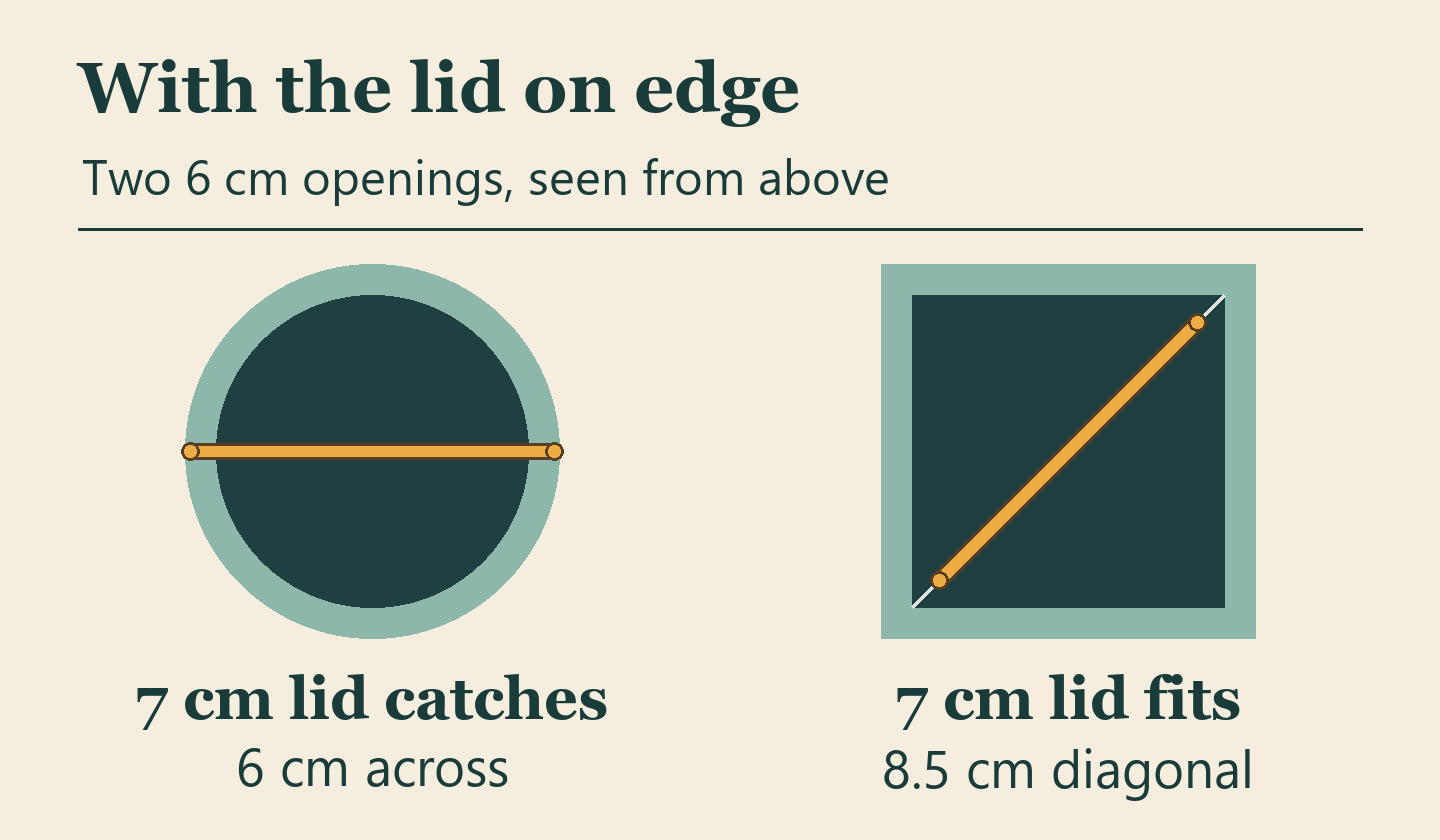
A round cover rests on a ledge that makes the opening beneath it narrower than the lid. Even on edge, the lid still measures a full diameter across, and there’s nowhere that wide in the round opening. A square opening has extra room between opposite corners. A thin square lid can slip through that way if its side fits along the diagonal.12
What holds the lid up?
Picture two pieces of stiff card on a kitchen table. One has a round hole six centimeters across. The other is a disk seven centimeters across. Center the disk over the hole. The disk overlaps the card by half a centimeter all the way around. That narrow ring supports the disk. That overlap does the work of the ledge in a manhole frame.12
Turlock, California, shows the arrangement in its sewer drawing. Seen from above, the lid is round. In a slice through the middle, its edges rest on what look like two little shelves. They’re opposite sides of one ledge running around the frame. The empty space between the inner edges of that ledge is the clear opening. In Turlock’s drawing, it measures twenty-four inches across.2
Can the disk sneak through sideways?
Hold the card with the hole a hand’s width above the tabletop. Stand the disk on edge over it, as if it were a coin about to roll. The bottom of the disk slips in. How far can it go before it catches?1
Imagine a straight pencil line across the disk, through its center and level with the table. For the center to pass through the opening, that whole line has to fit at once. It’s seven centimeters long. The longest straight line you can draw inside the round hole is six centimeters, straight through its center. Try another tilt. You could draw a new level line through the disk’s center, and it would still be seven centimeters long. The rigid disk can never get its middle past the ledge.12
What do the corners change?
Now use a square hole six centimeters on each side and a thin square card seven centimeters on each side. Laid flat and lined up, the card covers the hole. Stand it upright with one edge level. Which way would you turn that edge to give it the most room?1
Point it from one corner of the opening toward the opposite corner. That diagonal measures about eight and a half centimeters. The card’s seven-centimeter edge fits with room at both ends. Lower the card straight down. Every bit that follows is the same width as that first edge, so the whole card slips through. This works for our thin, loose card. A thicker lid or a larger one would need more room.1
The city with three-sided covers
In Nashua, New Hampshire, some older streets had triangular manhole covers. At a city meeting in 2019, an alderman recognized them from his neighborhood. Senior staff engineer Amy Gill explained that the city was replacing those manholes during lining or paving projects because the old openings no longer met the standards for getting people in and out.3
The ledge in Turlock’s drawing shows where the lid catches. The old openings in Nashua bring up the other half of the design question. Once the lid is off, is there enough room for a person to get through?23