
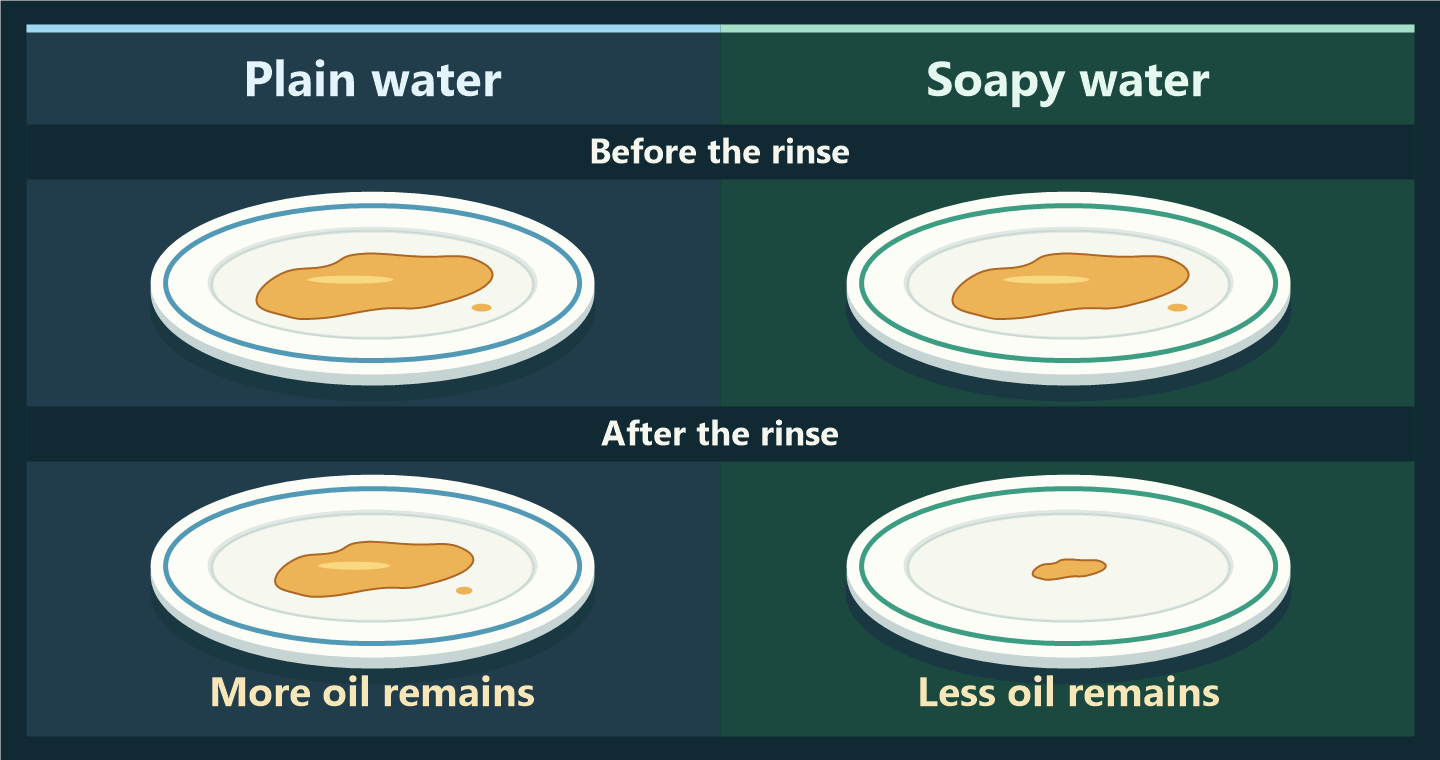
Dish soap helps grease loosen from a plate so the rinse can carry it away. Each cleaning molecule has a head that interacts with water and a tail that slips into grease. Those molecules also help keep loosened grease spread through the water in small droplets. That’s why the plate rinsed with soapy water can keep less of its oily film than the one rinsed with plain water.1234
Which plate keeps its shine?
I’m starting with two matching plates and spreading a thin layer of cooking oil on each. Same amount on both. Asher adds a little liquid dish detergent to one of two cups filled from the same tap. That’s our dish soap. We’ll use the same amount of water at the same temperature and hold the plates at the same tilt. Before either cup tips, which plate do you think will still have more of its oily shine?
Picture us pouring at the same speed. I pour plain water. Asher pours soapy water. When the plates stop dripping, look at them under the same light. Here’s what we’d expect. Mine still has a broad oily streak. On Asher’s plate, that streak is smaller. Where did the rest of his grease go?12
How does the oil lift off?
Start with Winston’s plate. Very little of that oil dissolves in plain water. A water molecule has a slightly positive side and a slightly negative side, so water molecules attract one another. The long, oily parts of grease molecules have very little of that charge difference. The two liquids mostly stay separate, so some oil can stay in a film or gather into drops on the plate.12
On my plate, zoom in on the edge of the oil streak where the oil, water, and plate meet. Dish soap contains surfactants, molecules that gather at boundaries like this. The tail of a surfactant can sit in the oil while its head stays in the water. Where they gather, they change the pull between the liquids. That can let soapy water get under the edge of the oil, where it meets the plate. The oil can draw up into a drop. With less of it touching the plate, the rinse can sweep it away more easily.13
Where does the grease go?
Follow the grease off Asher’s plate. As the rinse flows, some of the oil can break into smaller drops. Surfactants gather around those drops with their tails in the oil and their heads facing the water. That coating makes it harder for the little drops to join into bigger ones. When drops of one liquid are spread through another like this, it’s called an emulsion.145
Those tiny drops are still oil, and they go wherever the rinse water takes them. Look back at the spot where the oil streak was. Asher’s plate can lose more of that greasy shine because more of its oil went down the drain. If you still see a patch, a pass with a sponge can help loosen it for the next rinse.234