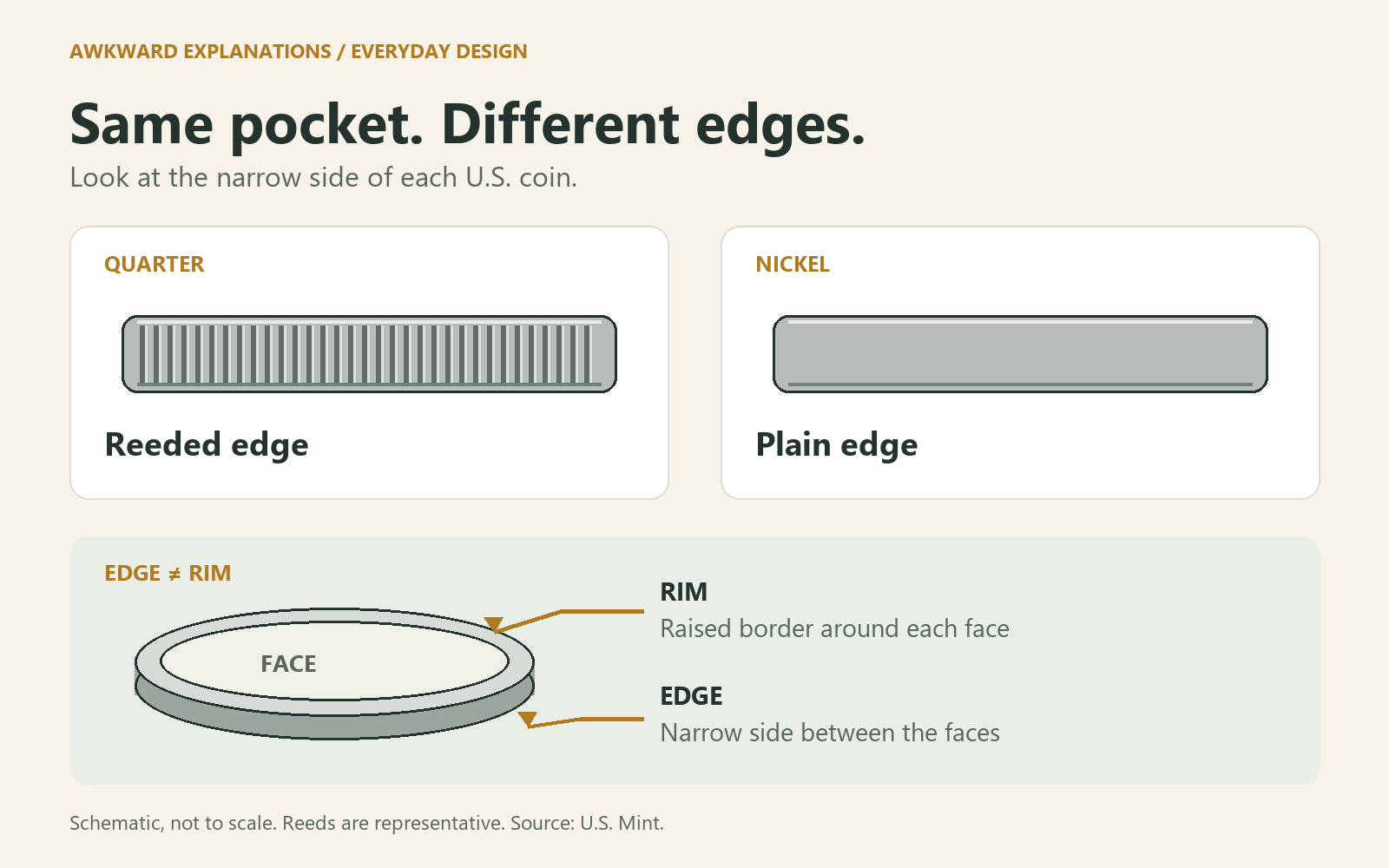
Ridges helped reveal when someone had shaved a coin for its silver or gold. Filing the edge could erase part of the pattern, called reeding.1 The U.S. quarter kept its ridges when its silver was replaced in 1965. The copper-nickel five-cent piece has a plain edge.23
Why does a quarter have ridges but a nickel doesn’t?
Hold a quarter and a nickel edge-on and run a thumbnail along each. Those little bumps on the quarter are called reeds. The U.S. Mint counts 119 on a modern circulating quarter. On a nickel, your thumbnail slides along a plain edge.23
The first U.S. quarter, minted in 1796, was silver. The nickel arrived in 1866 as a five-cent piece made of copper and nickel. Its metals gave a clipper little reason to bother with it.123 For a few years you could even get five cents in two different coins. The Mint kept making the smaller silver half dime until 1873.3
What was coin clipping?
Imagine getting a silver coin in change. You recognize the design on its face. Would you notice if the last owner had shaved a sliver off the side? That was clipping. The clipper kept the silver and passed the lighter coin along.1
A marked edge gave the next person something to check. File down a row of ridges and a smooth patch can give the game away. Letters worked too. On a coin with words around its edge, missing strokes could show where metal had been taken.1
How did England mark coins to discourage clipping?
In 1695, William Lowndes, England’s Treasury secretary, described how the mint marked its machine-made coins. The larger silver pieces got letters along their edges. The others got what he called “a Graining.” Lowndes credited both the coins’ thickness and their marked edges with protecting them against clipping.4
Why keep ridges when quarters aren’t silver anymore?
The U.S. Mint took silver out of circulating quarters in 1965 and switched to copper-nickel clad coins. The edge kept its familiar texture.2 Coin historian David Lange put the persistence of reeding on U.S. dimes, quarters and half dollars down to tradition. You can still feel the difference between a quarter and a nickel in your pocket today.123
What’s the difference between the edge and the rim?
Lay the nickel flat and trace the raised circle around its face. That’s the rim. There’s one on each face, and it helps protect the design from wear. Now tip the nickel sideways. The band between those two rims is the edge. On the nickel that band is smooth. On the quarter it’s where your thumbnail finds the reeds.235
How does the Mint put the ridges on?
The Mint starts the rim first. A machine called an upsetting mill squeezes a metal disk around its perimeter, pushing up a narrow lip.6
The quarter gets its reeds in the coin press. As two dies stamp heads and tails, the metal spreads outward against a ring called a collar. Grooves inside the collar leave raised lines on the coin. All 119 reeds take shape in the same strike that gives the quarter its faces.126