
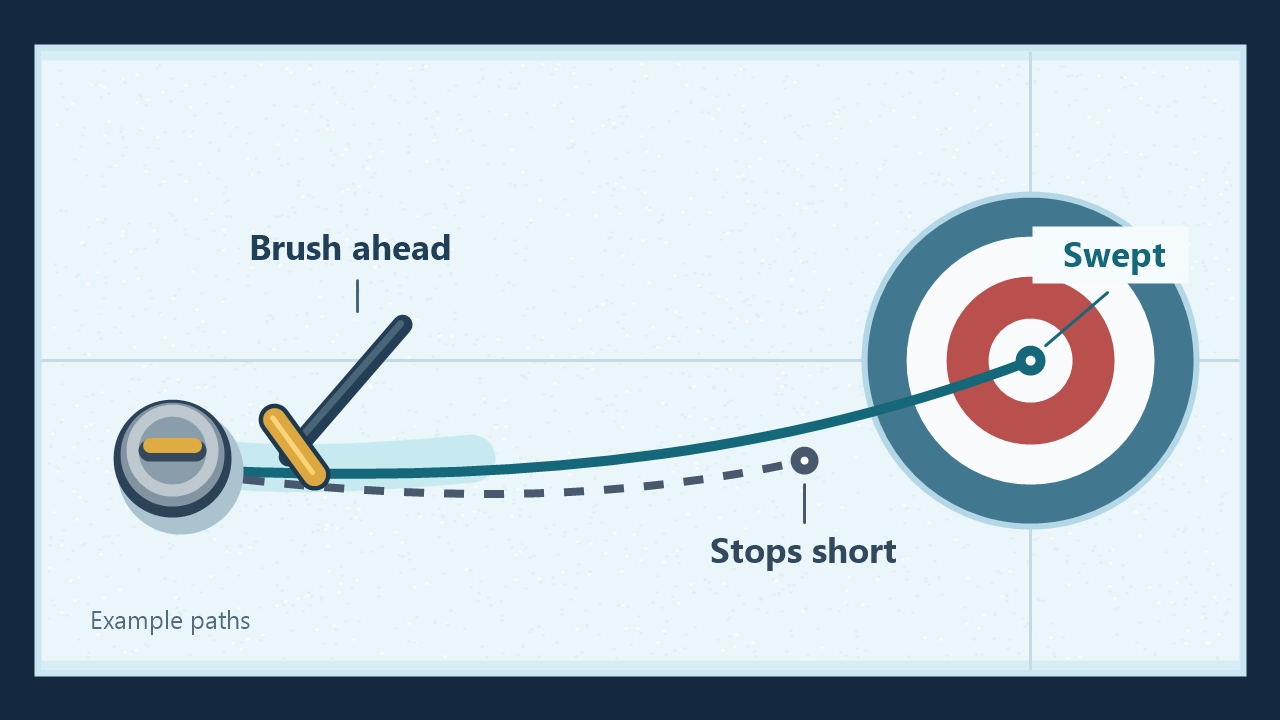
Curlers brush the ice just ahead of a moving stone. Brushing briefly warms the ice and can reduce friction, so the stone loses speed more slowly and can glide farther. Sweeping can also change how much its path bends. If the stone already has the speed and path it needs, the team calls the sweepers off so it can slow down on its own.1246
Follow the stone toward the rings
Watch the handle as a curler lets the stone go. A slight turn gives the stone a slow spin. Its path bends as it slides, which is the curl. The rings at the far end are called the house, and this team wants its stone to stop near the center.1
The stone is headed where the team wants, but it’s slowing down and might stop short. Look just ahead of it. That’s where the teammates brush. The stone rides on a narrow ring underneath, which touches the tops of tiny frozen bumps called pebbles. The brush passes over those bumps before the stone reaches them.1235
The brush buys the stone more glide
Rubbing the ice briefly warms the surface. When that reduces friction, the stone loses speed more slowly. It keeps more of the speed it already had and can travel farther before it stops. In one experiment, a launcher sent stones out at matched speeds. The swept stones slid farther than the unswept ones, and the size of the difference varied with the ice.245
Back to our stone. It’s still bending toward the center, and the sweepers judge that it has enough speed to get there. They lift their brushes to the side and let it glide. If they kept sweeping for distance, the stone could pass the center. Once they stop, the stone reaches ice they haven’t brushed and can slow down on its own.17
Watch where it stops, side to side
Suppose the stone had started to bend too soon. The team might sweep to hold its path straighter. At a rink in Japan, researchers compared thirty-nine pairs of shots. In each pair, they let one shot run untouched and swept the right half of the path on the other. The swept shots finished about seven centimeters farther left on average. The shots varied, and the launcher was set to send the stone out with almost no spin. A game shot can behave differently.16
A Canadian research team looked at the ice itself. Infrared video showed the tops of the pebbles warming, and close-up photos showed that brushing could round some of them. The team tested patches of ice, so those observations leave open how much each change affects a passing stone. Warming helps explain the extra glide. How the turning stone grips and slips over the pebbles is still being studied.2356
Next time you watch curling, pick a spot where you think the stone will stop. When the brushes come off the ice, keep watching through the stone’s last little turn. The team is betting the stone can finish the shot on its own.1