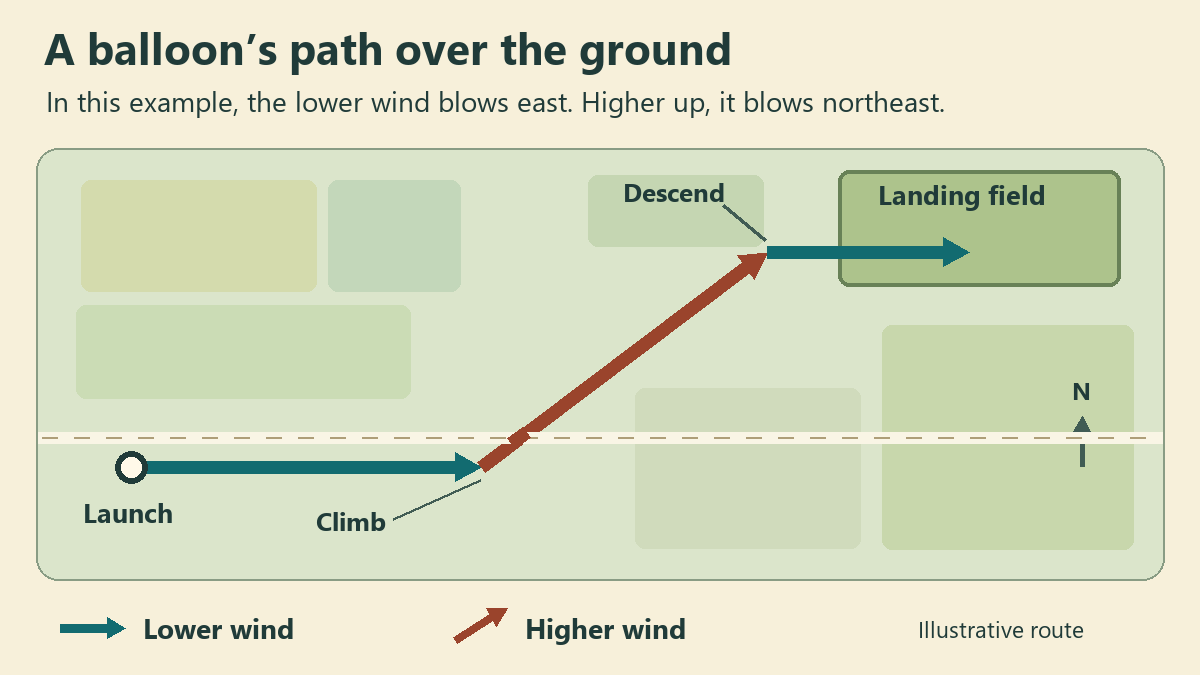
A hot-air balloon pilot steers by choosing which wind to ride. The burner heats the air inside so the balloon can climb. Letting the air cool, or releasing some through the top vent, lets it descend. If the wind at the new height blows a different way, the balloon’s path over the ground bends with it. The pilot can aim for a field only if the available winds lead there.136
Watch the little balloon first
Imagine you’re beside the basket before takeoff. The pilot releases a small helium balloon. At first it drifts east along a road. As it climbs, it starts drifting northeast, away from the road. A flag beside the basket could have told you which way the wind was blowing at the ground. That little balloon just showed you what the flag missed.24
Pilots call that little scout a pilot balloon, or pibal. Before the flight, a forecast helps the pilot choose a launch site with promising landing places downwind. The pibal gives the pilot a fresh look at the wind right here, this morning. Keep those two directions in mind. You’re about to need them.24
The field is to your left. Why climb?
Now you’re in the basket, traveling east along that road. Face the direction you’re moving. A wide field lies ahead and to your left, on the north side of the road. Stay in this wind and you’ll pass south of it. But remember where the little balloon went? There’s a breeze higher up that could carry you north as well as east.12
The pilot fires the burner. Heating the air inside the balloon gives it enough lift to climb. As it enters the higher wind, its path over the ground starts bending northeast. Look down and watch the distance between you and the road grow. You could turn around in the basket and face the other way. The balloon would still travel northeast with the air around it.156
How long should you ride the higher wind? Long enough to gain the distance north that you need, allowing for the fact that the balloon keeps drifting during the descent. The pilot can let the air inside cool or let some hot air out through the top vent. By the time you settle back into the lower wind, the field is due east. You’re traveling east again, just as you were at the start. Only now, the field is straight ahead. Trace the trip on a map and you can see what the pilot chose. East, then northeast, then east again.136
What if the wind has other plans?
Suppose the little balloon had traveled due east all the way up. A faster wind higher up could get you farther east in the same time. Neither wind could carry you north across that road. You could see the field perfectly and still have no route to it.12
That’s why a pilot checks the balloon’s track against landmarks or GPS and looks ahead for more than one place to land. A patch of grass can look inviting until you spot power lines across the approach. Even on the way down, the pilot watches for clues to the wind near the field. If the original field slips out of reach, the pilot looks for another with a clear approach. Sometimes the most important steering decision is which field to let go by.13