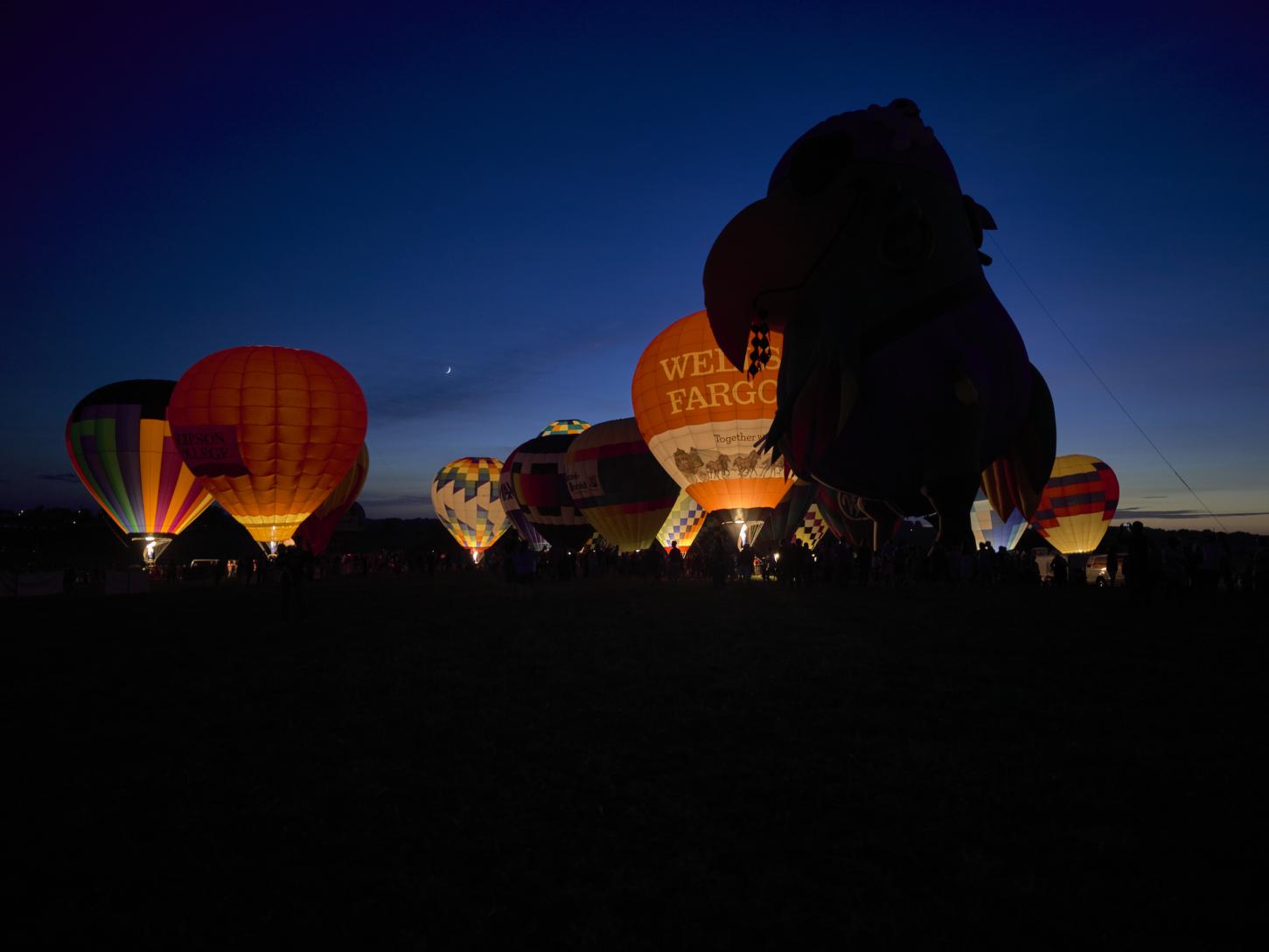
Warm air rises when it weighs less than the same volume of surrounding air. As air warms and expands, its molecules spread farther apart. Air pressure is a little higher below a pocket of warm air than above it. When that upward push outweighs the pocket, the warm air rises.123
What slips out when the burner fires?
Look just above the basket at the brightest part of a hot-air balloon. There’s a flame pointing up through a big opening in the fabric. That opening stays there for the whole flight. If you’ve ever pinched the neck of a party balloon to keep the air in, this is a peculiar way to build an aircraft.1
Picture the balloon upright and full, its basket still on the grass. The pilot fires the burner. Inside, the air molecules move faster on average. The mouth is open, so the pressure there stays close to the outside pressure. The warming air can expand. But the fabric is already holding about as much volume as it can, so some air spills out through the mouth. The balloon looks much the same, but it holds fewer molecules. A bucketful of the warm air now weighs less than a bucketful of the cooler air outside. That’s what lower density means.134
Who’s pushing the basket up?
Imagine drawing a box in the still air beside the balloon. Give it a flat top and bottom, and leave all six sides imaginary. Why doesn’t the air inside your box fall to the ground? It weighs something. Something must already be holding it up.2
Air presses in from every side. The air at the bottom of your box has a little more atmosphere stacked above it than the air at the top does. Pressure is therefore a little higher at the bottom. The upward push from below beats the downward push from above by just enough to support the air in the box. That difference between the two pushes is the buoyant force.2
Now give that imaginary patch of air the shape and size of the balloon. You know how much weight the surrounding air can support there. It was already holding up a whole balloon’s worth of cool air. Put the balloon in its place. The warm air inside weighs less, so there’s lift to spare for the fabric, the basket, the pilot, and you. Once the whole loaded balloon weighs less than the outside air it displaced, daylight appears under the basket.12
Can you feel it without the balloon?
Come in from the field and hold a hand in the air above a warm radiator. The air next to the radiator warms, expands, and weighs less than an equal volume of the cooler room air. Up it goes past your fingers. Cooler air moves in to take its place and gets a turn at the radiator. That movement carries heat around the room. It’s called convection.23
There’s a limit hidden in the word “warm.” What matters is how the rising air compares with its neighbors. As the plume mixes with room air and their densities even out, the upward push and the plume’s weight come back into balance. The balloon gave you a basket to watch. Above the radiator, your fingers can feel the rising air itself.23