
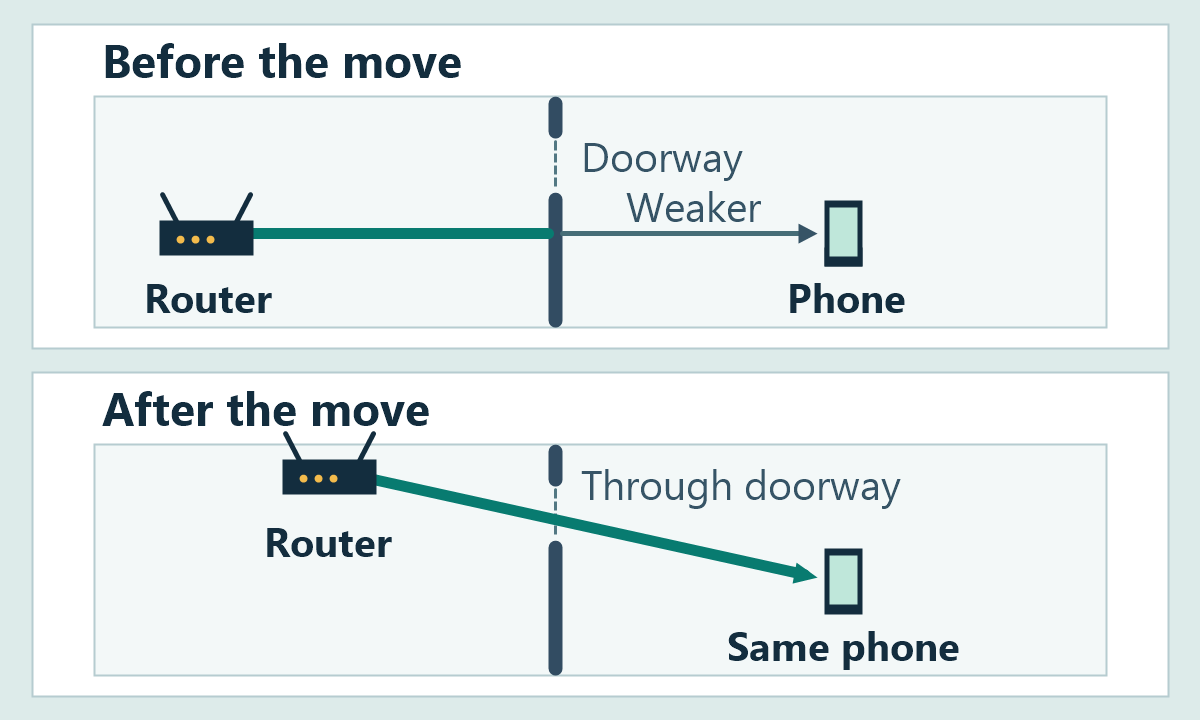
Some of a Wi-Fi radio wave can pass through a wall. The wall reflects some of the wave’s energy and absorbs some, so a weaker wave comes out the other side. Thick concrete can weaken the signal much more than thin drywall. Your phone can also pick up waves that bounce off surfaces or reach it through a doorway. Move the router so the direct path goes through that opening and the phone may get a stronger signal.234
Follow the signal to the next room
Start with the router in one room and your phone on the table in the next. The router encodes data by changing a radio wave in a pattern, then sends it out through its antenna. A passing wave makes a tiny electrical signal in your phone’s antenna, much as an FM broadcast does in a kitchen radio. The phone reads those changes to recover the data.156
Follow the part of the wave headed straight for the phone. Where it hits the wall, some of the energy bounces back. The wave’s changing electric field tugs on charges in the material, and some of the energy that enters the wall becomes heat. A wave still comes out the other side carrying the pattern. It’s weaker than it would be after traveling the same distance in open air.24
Swap what’s between the router and the phone
Keep the router, the phone and the Wi-Fi frequency the same. In the path between them, swap a thin sheet of drywall for a thick slab of reinforced concrete. In lab tests near five gigahertz, a frequency used by Wi-Fi, thin drywall let much more radio energy through. The samples differed in thickness as well as material. Both affect how much gets through, and so does the frequency.235
Your phone might still pick up a signal with the concrete in place. The router’s waves spread out, and some can take another route, like bouncing off a surface and passing through the doorway. The phone receives a mix of the wave that comes through the wall and waves that get there by other paths. Depending on how they line up, those waves can strengthen or partly cancel each other.14
Give the signal a path through the doorway
Leave the phone on the table and slide the router toward the open doorway. Trace a straight line between them again. In this setup, the line now runs through the opening. That part of the signal can reach the phone without losing energy in the wall. The phone may get a stronger signal even though it’s in the same spot.24
Distance still matters. The wave spreads as it travels, so all else being equal, a farther phone picks up less of it. As the signal gets weaker compared with the background noise, the phone has a harder time reading the data. A nearby room behind a thick wall can end up with worse reception than a farther room with an open path along the hall.145