A quantum computer can make some results more likely and others less likely before it gives you a reading. It does this with qubits. A qubit behaves in some ways like a wave. Just as two ripples can build each other up or cancel, a sequence of operations on qubits can strengthen or cancel contributions to a result. The programmer’s job is to find a sequence that makes the readings useful for a particular question.12
What can you learn from a blinking light?
In 2016, a team of physicists wanted to know how much energy it takes to pull a hydrogen molecule apart. Instead of pulling on two actual atoms, they built a model of the molecule on a chip. Two little electrical circuits on the chip represented possible states of the molecule’s electrons. When the team read those circuits, each gave them a zero or a one. How do you get from that to something a chemist wants to know?4
Let’s start with just one circuit. The unit of information it holds is called a qubit. Imagine it in a box with two lights marked zero and one. Press a button marked Read, and one light comes on. So far it sounds like an ordinary bit, the kind of thing your laptop uses to remember whether your microphone is on or off.1
What if you press Mix first?
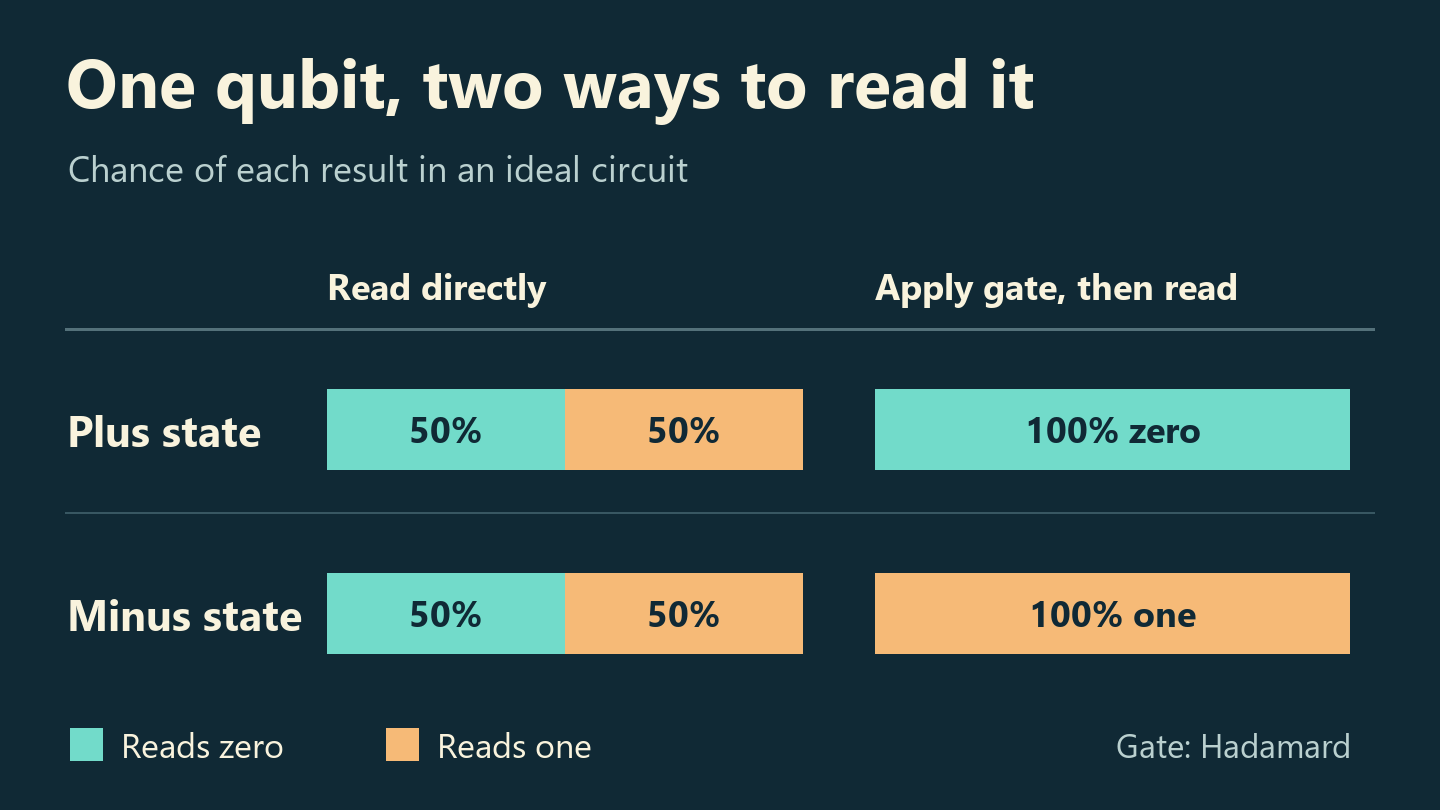
Give the box one more button, marked Mix. It does the same thing every time. To see how, follow just the zero light. Mix brings two contributions together. Their combined size determines how likely that light is to come on. In the plus setup, picture a crest meeting a crest. The contributions build each other up. In the minus setup, picture a crest meeting a dip. They cancel completely.12
Now make a prediction. Your friend chose minus. You press Mix, then Read. Can the zero light come on? Its contributions just canceled, so the answer is no. The only light left is one. For plus, the cancellation happens at the other light, so you get zero. On an ideal machine, one try tells you which setup your friend used.1
That building up and canceling is called interference. Mix is an example of a gate, one step in a quantum program. The order matters. If you press Read first, you get a random flash, and the qubit is left in the state for that result. By then you’ve lost the difference you were trying to find. Choose the right step before you read, and the flash can answer your question.12
What changes with a second qubit?
Give each of two qubits its own zero-or-one display. A gate can connect the qubits so that a reading gives you two zeros or two ones, with equal chances. Each display on its own looks random. Read them together and the two numbers always match in this example.3
Two ordinary lights wired to one switch can match, too. The difference shows up in what you can do next. Before you read the qubits, the two possibilities for the pair can still combine and interfere. The pair has a shared quantum state that you can only fully describe by taking the qubits together. That’s an example of entanglement.13
More qubits give a program more possible combinations to work with. Each time you run the program and read all the qubits, you still get just one string of bits. To see what those bits can tell you, let’s go back to the hydrogen molecule.34
Where does the energy number come from?
A hydrogen molecule is two atoms bound together. Its energy depends on how far apart the atoms are and on the state of their electrons. Electrons follow quantum rules. That gave the researchers a reason to use qubits. They could prepare the chip so its state represented a possible state of those electrons.4
First they picked a distance between the atoms in their model. Then they prepared the same electron state on the chip many times and measured it in several ways. Each kind of measurement told them about one part of the energy. An ordinary computer averaged the readings and added those parts with the weights specified by the model. That gave them one energy estimate.4
They tried other electron states to find the lowest energy at that distance. They did the same for other distances. The low point on the resulting curve is where the atoms bind. The rise from there to the energy of the separated atoms tells you how much energy it takes to pull them apart. That’s a number you could never get from one blink of a light.4
Hydrogen was small enough to check on an ordinary computer. That meant the researchers could compare their estimate with a known answer. A harder molecule would need its own comparison before anyone could claim a speed advantage.4
Why is this hard to build?
Remember the crest and the dip that made the zero light go dark? If the qubit is disturbed before those contributions meet, they might no longer cancel exactly. Now the wrong light can flash. A long program gives errors more chances to creep in.15
Researchers can spread one qubit’s worth of information over a group of physical qubits. They check relationships among the members for signs of errors while keeping the stored information available. The group acts as one protected qubit. In a test on Google’s Willow chip, one such group stored information for about two and a half times as long as the best individual qubit in that comparison. That tested memory. A calculation also needs gates that work accurately.5
If you remember the box, you have the basic idea. Press Read straight away and both setups look alike. Press Mix first and the same two lights can tell you which setup your friend chose. What makes the quantum computer useful is finding operations like that for a question worth answering.12