
Radio waves and visible light are ripples in the same electric and magnetic fields. What changes is the spacing between wave crests and how often they pass. A photon is a packet of light. A green photon can change the shape of a molecule in your eye and start a visual signal. A single FM radio photon carries far too little energy to do that. Yet the radio wave can push electrons back and forth in a metal antenna. That’s why the antenna can pick up the station while your eyes see the glowing dial.12356
Turn the volume all the way down
Picture a kitchen radio playing a song, its dial glowing green. Turn the volume down until the kitchen is quiet. Is the station still in the room? Turn the volume back up. The singer has carried on without you. The broadcast was reaching the antenna the whole time.2
What traveled from the station to your kitchen? A ripple in electric and magnetic fields. Put a wire in its path, and the electric field pushes electrons in the wire first one way, then the other. That’s what happens in the radio’s antenna. The receiver tunes in one station and recovers the music from tiny shifts in the wave’s frequency. Then it drives the speaker back and forth. The speaker makes the air vibrate, and those vibrations reach your ears as sound.12
How long is one wave?
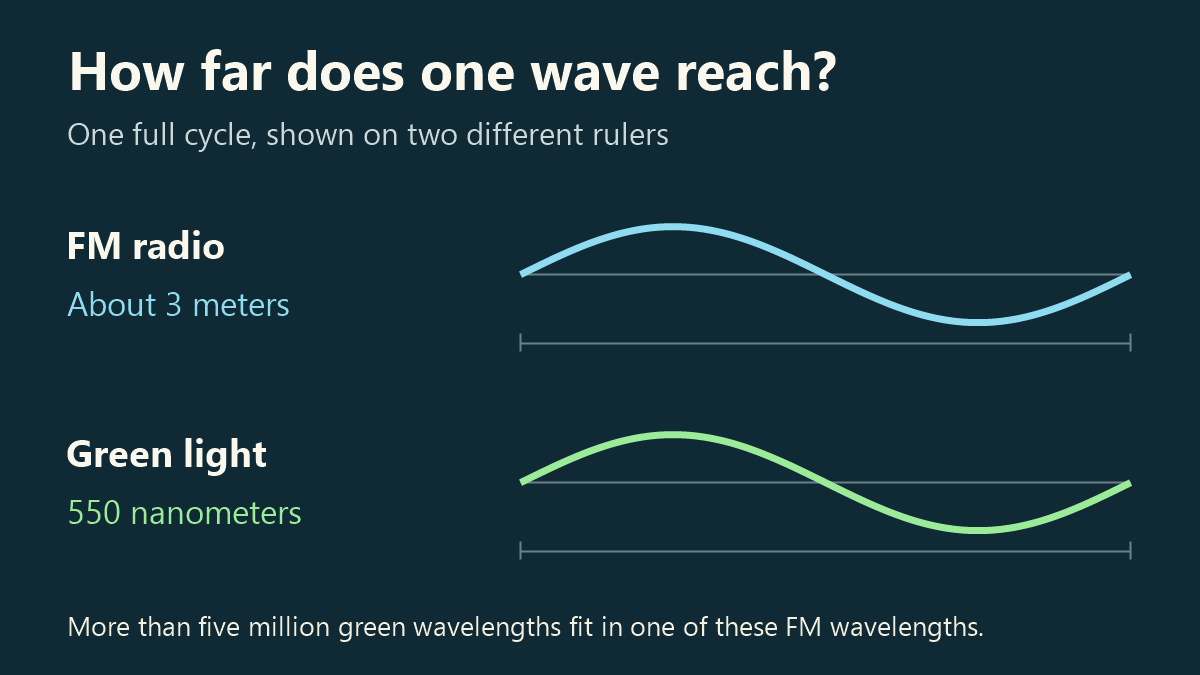
Now look at the green dial. It sends out a ripple in those same fields. Imagine freezing both waves in midflight. Measure from one crest to the next, and you have the wavelength. For an FM station near 100 megahertz, you’d need a ruler about three meters long. Pick a shade of green with a wavelength of 550 nanometers. More than five million of those green wavelengths fit in the space of one FM wavelength.13
Let the waves move again. In empty space both travel at the same speed. The green crests are closer together, so more of them pass you each second. That count is the frequency. A station at 100 megahertz sends about a hundred million cycles past you every second. Frequency also tells you how much energy the wave can deliver in one packet, called a photon. The higher the frequency, the more energy each photon carries.13
Start with long radio waves and work toward shorter wavelengths. You’ll pass through microwaves, at the short end of radio, then infrared. Next comes the rainbow, from red to violet. Beyond violet come ultraviolet, X-rays and gamma rays. The rainbow ends, but the spectrum keeps going. Even the boundary we draw between deep red and infrared is gradual to a human eye. In everyday conversation, “light” usually means the part we see. In physics, the word can cover the whole spectrum.348
What does your eye do with one green photon?
Follow one green photon from the dial. The cornea, the clear front of your eye, works with the lens to focus light onto the retina at the back. Inside the retina’s light-sensitive cells is a pigment that holds a tiny, bent molecule called retinaldehyde, a form of vitamin A. When the pigment absorbs the photon, the molecule can straighten. That change sets off a chain of reactions that alters the cell’s electrical signal. Signals from the retina then travel along the optic nerve to the brain. A single FM photon carries far too little energy to trigger that change of shape.1356
So where does the green come in? One cell can register that it caught light. To get color, your visual system compares cells. Most people have three kinds of cones. Each responds to a range of wavelengths, and those ranges overlap. A green dial and a red dial excite the three kinds in different proportions. You experience those different patterns as different colors. Rods, another kind of light-sensitive cell, help you find your way when it’s too dim to make out colors.7
What’s left when the dial goes dark?
Human eyes ordinarily pick up wavelengths from roughly 380 to 700 nanometers, with sensitivity fading near the edges. Ultraviolet photons, just beyond violet, carry more energy than visible photons. So why don’t they look like one more color? For one thing, your lens absorbs much of that ultraviolet before it can reach the retina.37811
Think of the kitchen in daylight. The Sun gives off plenty of light in the range our eyes can detect, and much of that light gets through the atmosphere. Some bounces off the rim of a cup and into your eye. Some bounces off the face of the person holding it. That makes this band particularly useful for seeing what’s around us on Earth.89
Now go back to the dark kitchen and switch off the radio. Hold up your hand. You can lose sight of your fingers even as your skin gives off infrared light. A thermal camera can collect that light and show the outline of your hand on its screen. The moment the green dial went out, the kitchen looked dark to you. Your hand was glowing the whole time.10