
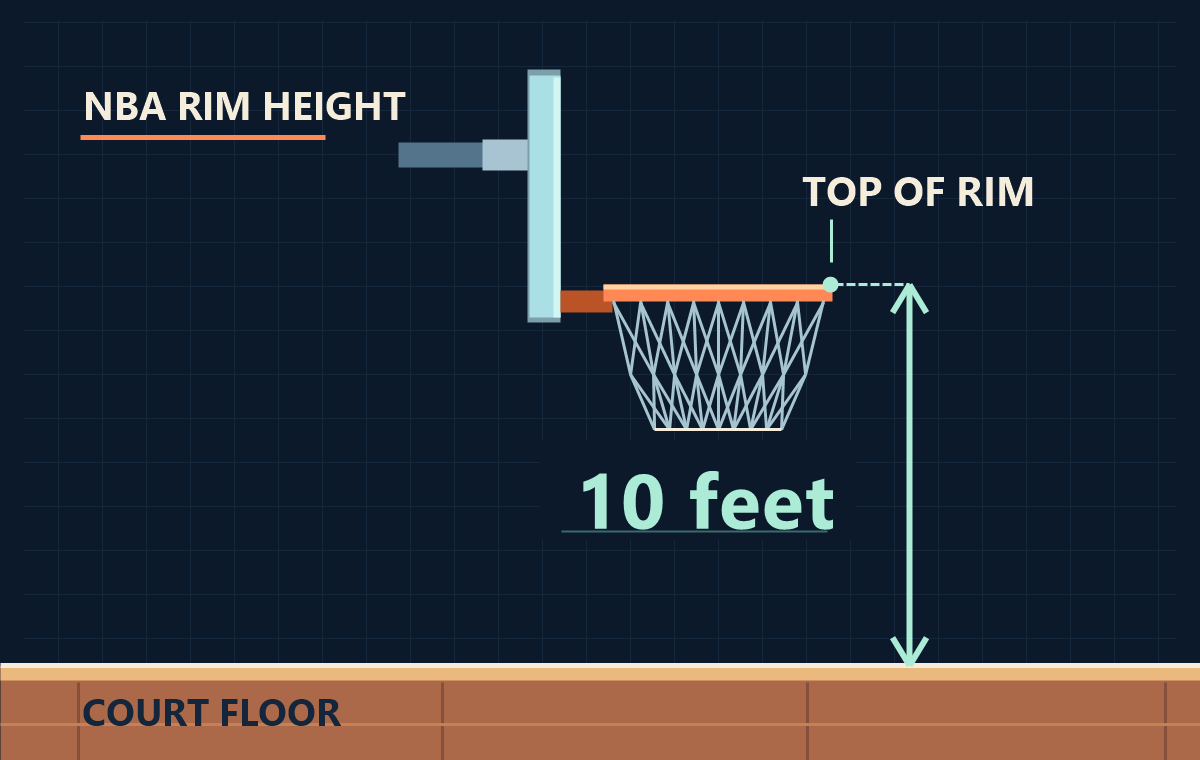
On an NBA court, the top edge of the metal rim sits ten feet above the playing floor. James Naismith wanted a raised target. He hung two peach baskets on a balcony rail that Springfield College says was ten feet above the gym floor.124
The gym already had a place to hang it
Picture a gym in Springfield, Massachusetts, in 1891. You have a ball and need a goal at each end. Put a box on the floor and defenders could crowd around it. James Naismith later recalled that he wanted a target above the players’ heads, with an opening that faced up. To make the shot, you’d send the ball up in an arc and let it drop in.12
Naismith asked for boxes and got two peach baskets. He recalled nailing one to the lower balcony rail at each end of the gym. Springfield College puts that rail ten feet above the floor. Raising the goal was part of his design. The spot he found in the gym gave it its height.12
Where the tape measure stops
By January 1892, Naismith was telling readers how to set up the game in other gyms. In The Triangle, he suggested hanging the baskets from the railing of an indoor running track or mounting them on the walls in a gym without one. He gave the height as about ten feet above the floor and left the exact measuring point on the basket unspecified.3
Now stand under an NBA basket with a tape measure. Start at the court floor and go straight up to the top edge of the orange metal ring. That’s where a shot drops into the hoop. The net hangs below it, and the backboard rises above it. The NBA sets that top edge at ten feet. FIBA’s equipment diagram marks the same floor-to-rim distance at about 3.05 meters.45
Why some kids play with lower hoops
If a hoop at a kids’ practice looks low, it may be set that way on purpose. USA Basketball and the NBA recommend eight-foot baskets for seven- and eight-year-olds and nine-foot baskets for nine- through eleven-year-olds. A lower rim gives younger players a better chance to make shots while they learn shooting form.6