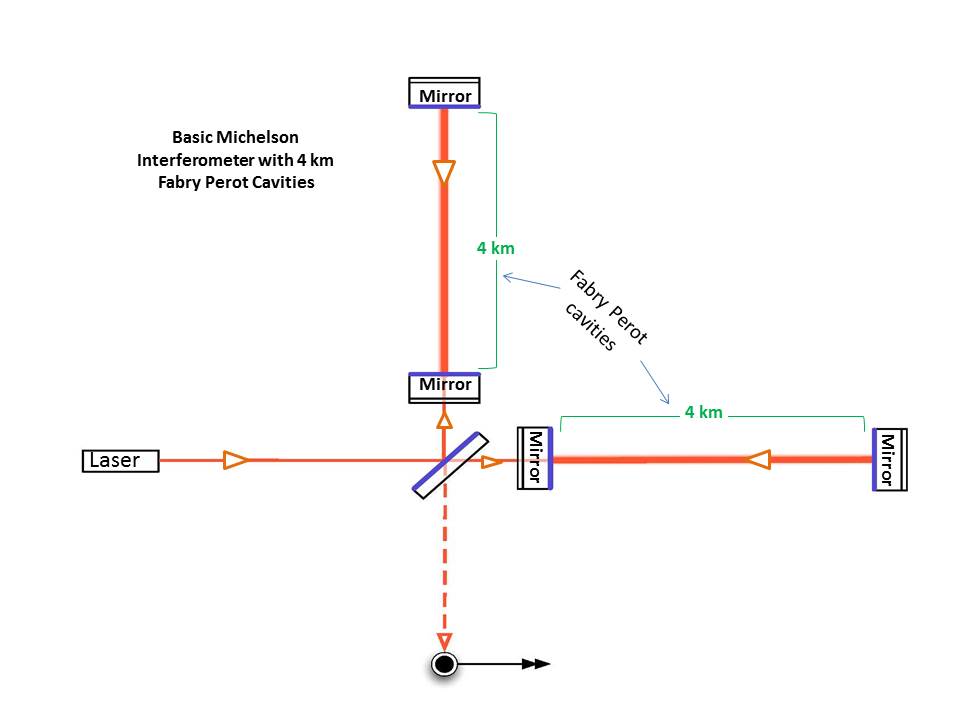
LIGO uses laser light to compare the lengths of two arms. A passing gravitational wave can stretch one arm while squeezing the other. Light traveling the longer path takes a little more time to return. When the beams meet again, that difference changes how their waves line up and how much light reaches a sensor. The changing brightness lets scientists trace the ripple as it passes.123
One laser takes two routes
Imagine standing at the corner of a giant L. Straight ahead is a mirror four kilometers away. Turn a quarter turn and there’s another one just as far away. This is the layout of a detector at LIGO, the Laser Interferometer Gravitational-Wave Observatory. At the corner, a partly reflective piece of glass splits a laser beam. Some light goes straight through the glass and some turns the corner. The mirrors send both beams back.1
Now picture a gravitational wave arriving from overhead. It’s a ripple in spacetime that changes the distances between suspended mirrors. Suppose its stretch runs along one arm of the L. As that arm stretches, the other squeezes. Half a cycle later they trade places. Light takes a little longer to make the round trip along the stretched arm than along the squeezed one. How could you measure a difference that small?23
The returning light does the timing
Light is a wave. Picture the electric field of each returning beam as a row of crests and troughs. Where the beams overlap, their fields add together. A crest meeting another crest gives a bigger wave. A crest meeting an equal trough cancels it. That adding and canceling is called interference, which gives the instrument its name.2
At the exit leading to the light sensor, LIGO adjusts the mirrors so that crests from one arm meet troughs from the other. The cancellation is almost complete. Only a faint glow reaches the sensor. Now give one beam a slightly longer trip. Its crests arrive a little later in the other beam’s cycle, changing how much the waves cancel. As the arms stretch and squeeze in turn, the light at the sensor brightens and dims.24
Why build the arms so long?
A gravitational wave changes a distance by a fraction of its length. Double the length and the same fraction gives you twice the change to measure. For LIGO’s first detection, even four kilometers barely gave the wave any room to work. At its peak, the difference between the arm lengths changed by about four billionths of a billionth of a meter. Divide that change by the usual length of one arm and you get what physicists call strain. It tells you how strongly that particular detector felt the wave.13
There’s also a second mirror in each arm, close to the corner. It faces the mirror at the far end, so light bounces back and forth between the pair many times before the two beams reunite. Those extra trips give the timing shift a chance to build up, making its effect easier to see. To translate the sensor reading into strain, scientists check how the instrument responds when a separate laser gives a mirror a tiny, known push.134
How did they recognize a black hole merger?
A shaking floor can move a mirror, too. LIGO hangs each main mirror at the bottom of a chain of four pendulums. Each stage helps keep ground vibrations from reaching the glass. Sensors measure motion at the platform supporting the chain, and actuators push back to steady it. Even with all that engineering, a flicker at one site still needs an explanation.5
On September 14, 2015, the detector in Livingston, Louisiana, picked up a signal whose cycles came faster and faster. About seven milliseconds later it reached Hanford, Washington. That delay fit a ripple sweeping past the two sites at the speed of light. The detectors face different directions, so the researchers flipped one trace upside down and shifted it in time to compare the two. The peaks lined up. Environmental sensors at both sites showed no disturbance that could explain the signal.36
The clue to what made the ripple was its rhythm. As two black holes lose energy to gravitational waves, they spiral closer and orbit faster. Their waves cycle faster, too. When the holes merge, the newly formed black hole briefly rings like a struck bell, and the waves fade. Scientists compared that predicted rise and fade with the strain measured at both sites. The match is how a change in laser brightness revealed the last orbits of two black holes and the settling of the one they became.36