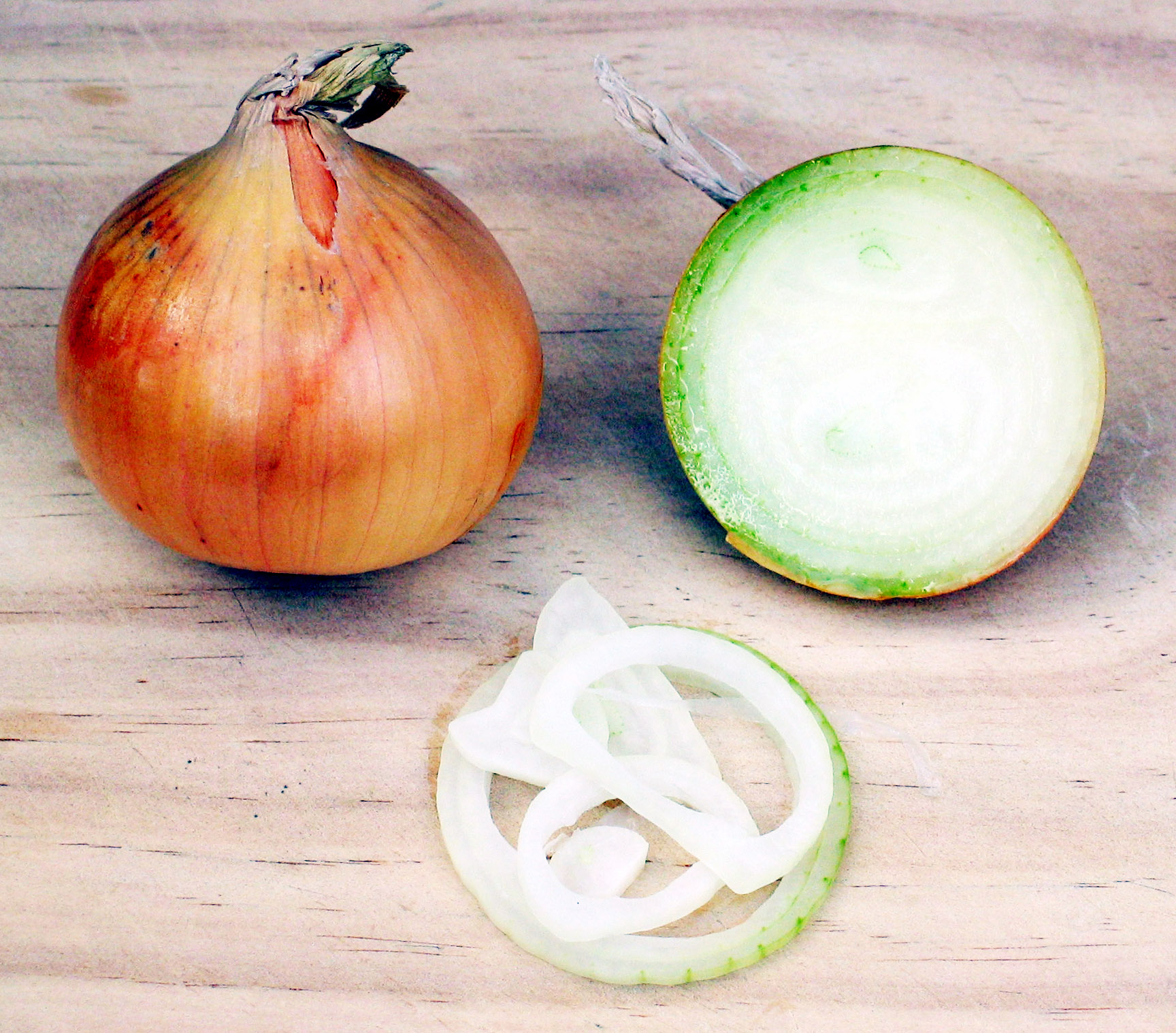
Slicing an onion breaks open cells and brings together ingredients the intact bulb keeps apart. Two enzymes turn a sulfur compound into an irritant that can escape as a vapor.123 If it reaches your eyes, sensory nerves trigger a reflex. Your tear glands release extra fluid that helps wash the irritant away.24
What changes with the first slice?
Picture a whole onion on the cutting board. You can lean in to find the root end and your eyes usually feel fine. Slice it in half and you can see the rings. Look closer in your mind’s eye. Each ring is made of cells, and the barrier that matters is inside each cell.1
An onion cell holds an enzyme called alliinase in a sac called a vacuole. An enzyme is a protein that speeds up a chemical reaction. The sulfur compound that alliinase acts on sits just outside that sac, in the same cell. As long as the membrane between them holds, the two stay apart. A knife tears through those membranes along the cut, and the ingredients meet in the juice.12
What forms in the onion juice?
Alliinase splits the sulfur compound, leaving a short-lived acid. A second enzyme rearranges that acid into the substance that stings your eyes. Scientists call it the lachrymatory factor. If you’re the one chopping dinner, “the thing that makes me cry” will do.2
Researchers worked out what that second enzyme does by leaving it out. First they mixed the starting compound with both enzymes and detected the tear-maker. Then they tried the mixture with only the first enzyme. It could still split the starting compound, but this time the researchers couldn’t detect the tear-maker. All that chemistry happens on the cutting board, before the onion ever hits the pan.2
How does it cross the counter?
Back to the table. You’ve picked up a fork, and your eyes start to sting even though you never touched the onion. The tear-maker can escape from the juice as a vapor. If air from the cutting board drifts toward your face, it can carry the irritant to both eyes. How much reaches you depends on which way the air moves. That’s why there’s no fixed distance at which someone across the counter starts to tear up.23
The cornea, the clear front surface of each eye, has sensory nerves that respond to irritation. When the onion vapor stings, those nerves trigger a reflex that tells your tear glands to release more fluid. The extra tears spread across the surface and help wash the irritant away. One person sliced the onion. The person holding the fork has a perfectly good reason to reach for that tissue.24