February 29 keeps the seasons from drifting across the calendar. A cycle of the seasons lasts about 365 days, five hours and 49 minutes. Over four years those extra hours come to about 23 hours and 15 minutes. Adding a whole day gets the calendar close. Skipping three leap days every 400 years brings it closer still.12
Where would the March equinox go?
Suppose the March equinox falls on March 20. That’s the moment the Sun passes directly over Earth’s equator on its way north. Circle the date on a calendar that gives every year exactly 365 days. When you turn back to March 20 a year later, the equinox is still nearly six hours away. A full cycle of the seasons, called a tropical year, averages about 365.2422 days.14
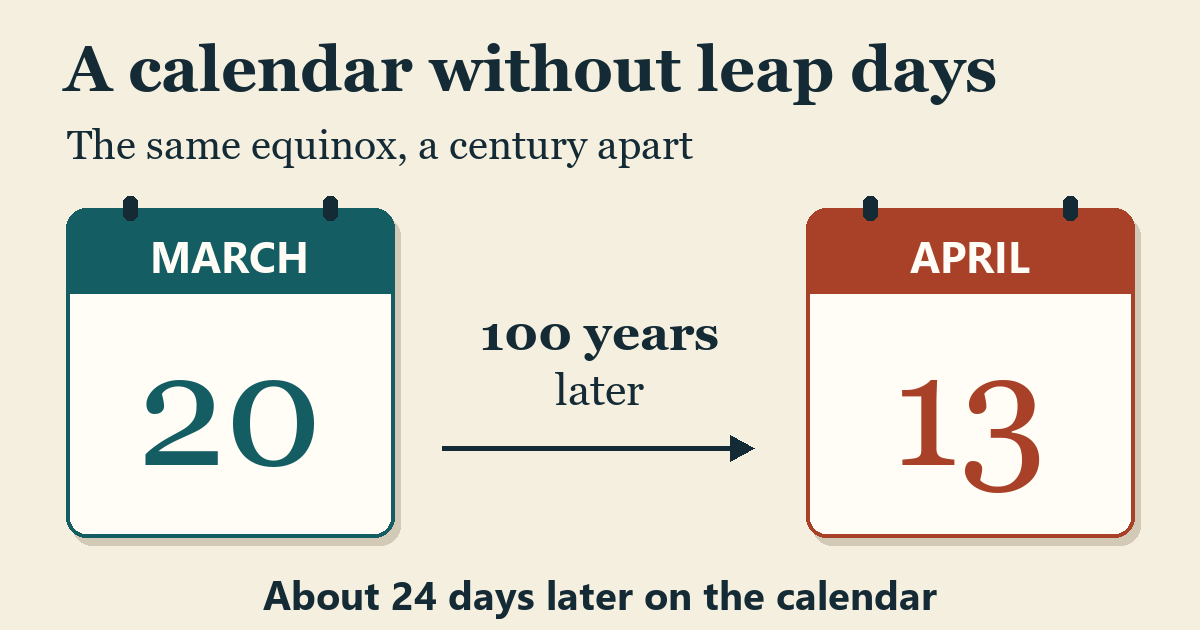
Keep using that calendar. After four years you’d move your circle about one square later. After a hundred years you’d have to turn the page to April and circle the 13th. The seasons would carry on as usual, but the equinox would fall about 24 days later on the calendar.12
Why did 2000 get a leap day when 2100 won’t?
Now give that calendar a February 29 every fourth year. March 1 waits an extra day, so the equinox moves back about one square toward the date you circled. Spread one extra day across four years and the calendar year averages 365.25 days.12
Look more closely at those four years. Each cycle of the seasons takes about five hours and 49 minutes beyond 365 days. Four of those remainders add up to about 23 hours and 15 minutes. February 29 adds a full 24 hours. That gives the calendar about 45 minutes more than it needs each time.12
In 400 years there are 100 chances to add a leap day. Forty-five spare minutes a hundred times comes to about 75 hours, a little over three days. With all 100 leap days in place, the seasons would finish their cycle before the calendar year caught up. The equinox would creep toward earlier dates.12
The Gregorian calendar skips three of those 100 leap days. You can spot them by looking at years that end in two zeros. A century year gets a February 29 only if 400 divides into it evenly. In 2000 it did, exactly five times. In 2100 it won’t, so February 28 will lead straight to March 1.12
Count from 2000 through 2399. Keep the leap day in 2000 and skip it in 2100, 2200 and 2300. That leaves 97 leap days. Spread those across 400 years and the calendar year averages 365.2425 days, close to the 365.2422 days we set out to match.1
Does a leap year need a leap second?
No. You can pencil in February 29 centuries ahead. A leap second depends on measurements of Earth’s uneven spin. At the end of 2016, a clock showing Coordinated Universal Time, or UTC, could tick from 59 seconds to 60 before midnight. That extra tick kept UTC, which is based on atomic clocks, close to time measured by Earth’s rotation.13