
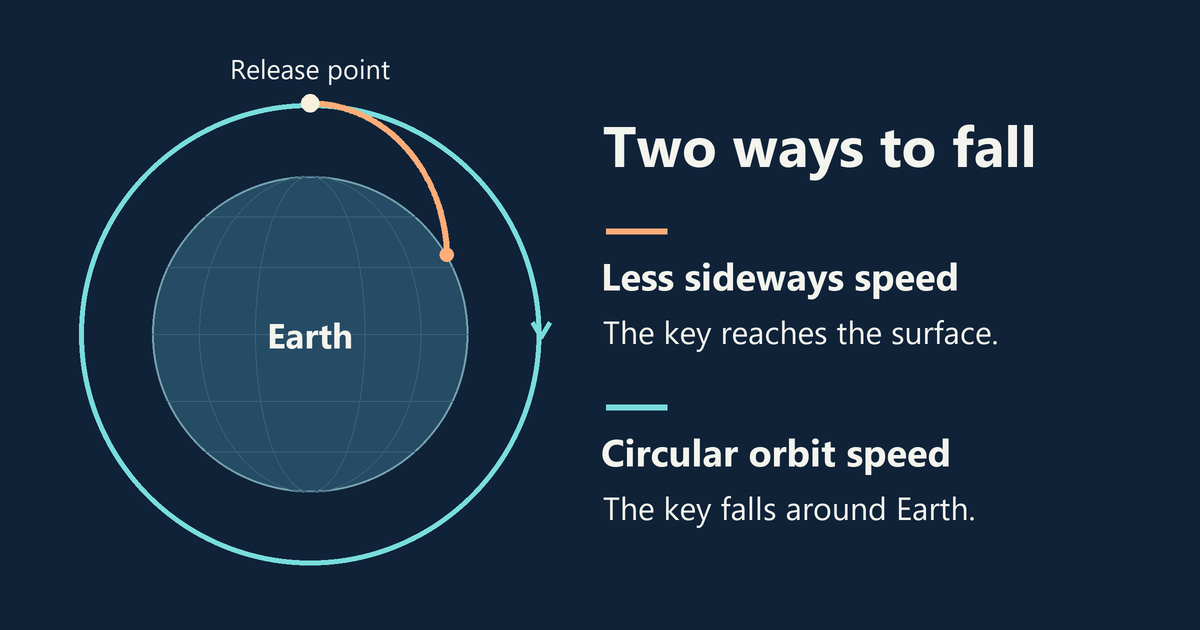
Gravity draws objects with mass toward each other. Earth pulls on a key whether it rests on your palm or floats beside an astronaut. On the ground, you feel the key press against the hand that supports it. In orbit, the astronaut, the key and the whole cabin fall together. They’re moving sideways fast enough to keep missing the ground.124
What can you feel in the palm of your hand?
Hold a key flat on your palm, then turn your hand over. The key slips off and picks up speed on its way to the floor. Earth was pulling on it the whole time. Turning your hand took away the support that kept it still.12
Isaac Newton described gravity as an attraction between anything that has mass and anything else that has mass. More mass means a stronger pull at the same distance. The attraction goes both ways. The key pulls on Earth just as hard as Earth pulls on the key. But the same force barely changes the motion of a whole planet. It makes a much bigger difference to the little key.1
Set the key on your palm again. Your skin presses up on the metal, and the metal presses down on your skin. A kitchen scale can measure that push. Now picture the key resting on the scale. What would it read if you let go of the whole thing?2
Drop the scale, too
For a moment, ignore air resistance. Once you let go, gravity gives the key and the scale the same downward acceleration. They pick up speed together. The platform no longer has to hold the key up, so the key stops pressing on it. An ideal scale, one that responds instantly, would read zero. The key still has all its mass, and Earth is still pulling on it.12
Researchers can get a few seconds of that weightless feeling underground. At NASA’s Glenn Research Center in Cleveland, they pump nearly all the air out of a deep shaft, then release a container carrying an experiment. The container and its contents fall together for 132 meters. For just over five seconds, researchers can watch what happens in near-weightlessness. At the bottom, the container slows to a stop.3
How do you make the fall last?
Imagine taking the key high above the atmosphere and giving it a gentle sideways push. It travels sideways as it falls and lands some distance from where you let go. Start again at the same height and give it more sideways speed. It goes farther before it hits. Now picture the ground beneath that longer path. Earth is round, so the surface curves away from the key.4
Give the key just the right sideways speed and something remarkable happens. In the time it takes the key to fall toward Earth, the surface beneath it curves away by the same amount. A moment later the key is still at the same height, moving in a slightly different direction. Keep tracing that path and you get a circle. That’s one possible orbit. Gravity keeps turning the key’s motion all the way around.4
Gravity weakens with distance from Earth’s center. Even at ground level, that center is thousands of miles below your feet. Go another 250 miles up, about the height of the International Space Station, and Earth’s pull is still roughly nine-tenths as strong as it is at the surface. When an astronaut opens her hand there, the key already shares her sideways speed. From Earth, the whole cabin is racing around the planet. From inside, the key seems to hover by her fingertips because the station, the astronaut and the key are all falling together.124
What does Einstein’s account add?
Newton’s rule lets us calculate how the key’s path bends. Albert Einstein’s theory of general relativity gives us a way to understand why. Try this on a globe. Put two fingers on the equator a few inches apart. Run each finger due north. Neither finger turns east or west, yet they meet at the pole. On a curved surface, two travelers can each go straight ahead and still draw closer together.5
The globe shows what curvature can do in space. Einstein’s theory brings time into the picture, too. Where an event happens and when it happens belong to a single geometry called spacetime. Earth’s mass curves spacetime around it. A freely falling key follows the straightest path it can through that geometry. Depending on its starting speed and direction, we can see that path as a drop to the floor or a journey around the planet.56
Even light follows that geometry. When light from a distant galaxy passes a massive cluster of galaxies on its way to us, the cluster bends its path. Through a telescope, the distant galaxy can look stretched into an arc.6
Back on Earth, open your hand one last time. The floor holds you up while the key is free to fall, so you see it get away from you. Up on the space station, the astronaut opens her hand and the key stays close. She’s already falling with it.25