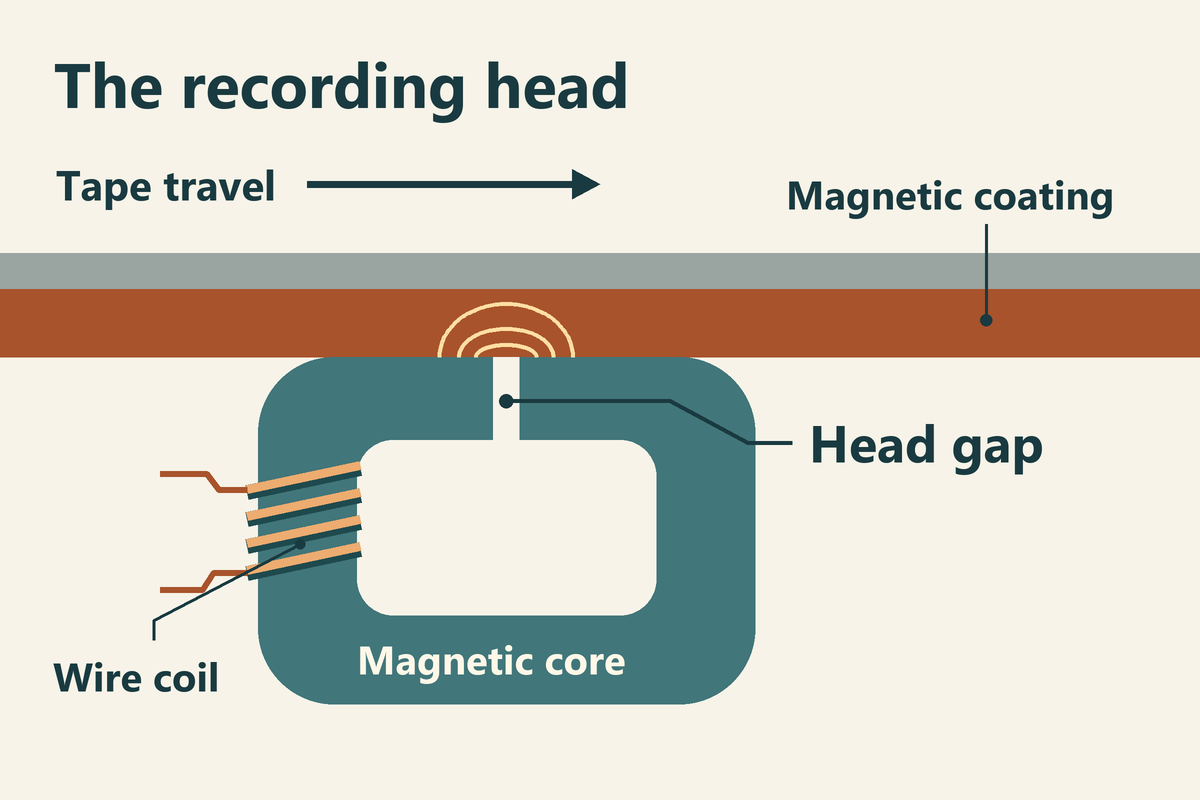
A cassette stores a guitar note as a magnetic pattern along a strip of tape. During recording, current in a coil makes a magnetic field that reaches into the moving tape. Each patch of coating stays magnetized as it leaves the head. On playback, those patches pass the head again, changing the field through its coil and generating a tiny voltage. The amplifier follows that signal and draws on its own power supply to move the speaker cone. Its motion sets the air vibrating, and you hear the pluck again.245
What reaches the tape when you pluck the string?
Press Record and pluck the open A string on an acoustic guitar. Listen for the tick as your finger lets go. Underneath it is a low note that rings on after the tick has gone. How does a ribbon keep both?
At the microphone, changes in air pressure move a thin diaphragm. In a moving-coil mic, a tiny coil of wire moves with that diaphragm in a magnet’s field. The motion generates a voltage. The first quick changes in that voltage follow the tick. Then the signal swings with the ringing string, growing weaker as the note dies away.1
What changes on the brown ribbon?
Look through the cassette window. One reel winds up the ribbon as the other lets it out. Down at the open edge, a rubber roller presses the tape against a spinning shaft called the capstan. Together they draw the tape steadily across the recording head. On this cassette, the side brushing the head carries a coating of tiny iron oxide particles that can stay magnetized.23
The recorder uses the mic signal to drive current through a coil wound around the head’s magnetic core. There’s a narrow break in that core, called the head gap. Here the field arcs out into the coating. As the audio current changes strength and direction, so does its magnetic field. The recorder adds a much faster back-and-forth current, called bias, to help the coating follow the audio signal with less distortion.26
Pick one tiny patch of coating and follow it past the gap. As it leaves the field, its particles keep an overall magnetization, with a strength and a direction. A moment later the next patch leaves with its own. The tick at the start of the pluck leaves fine changes close together. The ringing A leaves a repeating pattern whose swings get smaller as the note fades. Slip the cassette into your pocket and that whole sequence goes with you.26
Why does the tape have to move again?
Rewind to the pluck and press Play. A cassette deck can use the same head for both jobs. This time, as each recorded patch slides past the gap, it changes the magnetic field in the core. The coil surrounds that core, and the changing field generates a small voltage across its wire. Stop the tape and the last patch is still magnetized. It takes the arrival of the next patches to keep the signal going.23
Suppose the A string vibrates 110 times in one second. At normal cassette speed, roughly 4.8 centimeters of tape pass the head in that second. All 110 repeats fit in less than two inches. Now imagine playing that same strip at half speed. How long will that one second of music last?23
Two seconds. The head now reads 55 repeats each second, so you hear an A an octave lower, and the note takes twice as long to fade. Now try a different experiment. Record the pluck on slower-moving tape and play it back at that same slower speed. The pitch comes out right. But the fine changes from the tick are now packed closer together. When opposite parts of the pattern fit across the playback gap at once, they partly cancel, and the tick can lose some of its brightness.2
What gives the speaker enough power?
The playback coil responds to how quickly the magnetic field through it changes. For the same swing in field strength, a faster change produces a larger voltage. The deck’s playback electronics amplify the tiny signal and correct the balance between bass and treble. The low ring and the bright tick can travel down the cable together.26
At the other end, the signal tells the power amplifier when and how hard to drive the speaker. In our plug-in system, the amplifier draws the energy for that job from the wall. It sends current through a coil attached to the speaker cone. In the speaker magnet’s field, that current pushes the coil one way. When the current reverses, so does the push. The cone moves with the coil, making fresh pressure waves in the air.45
Play the original recording at normal speed once more. This time, turn up the volume. The cone moves farther and the pluck sounds louder. How many repeats went past the head in that first second? Still 110. You can fill the room without changing a single patch of tape.245