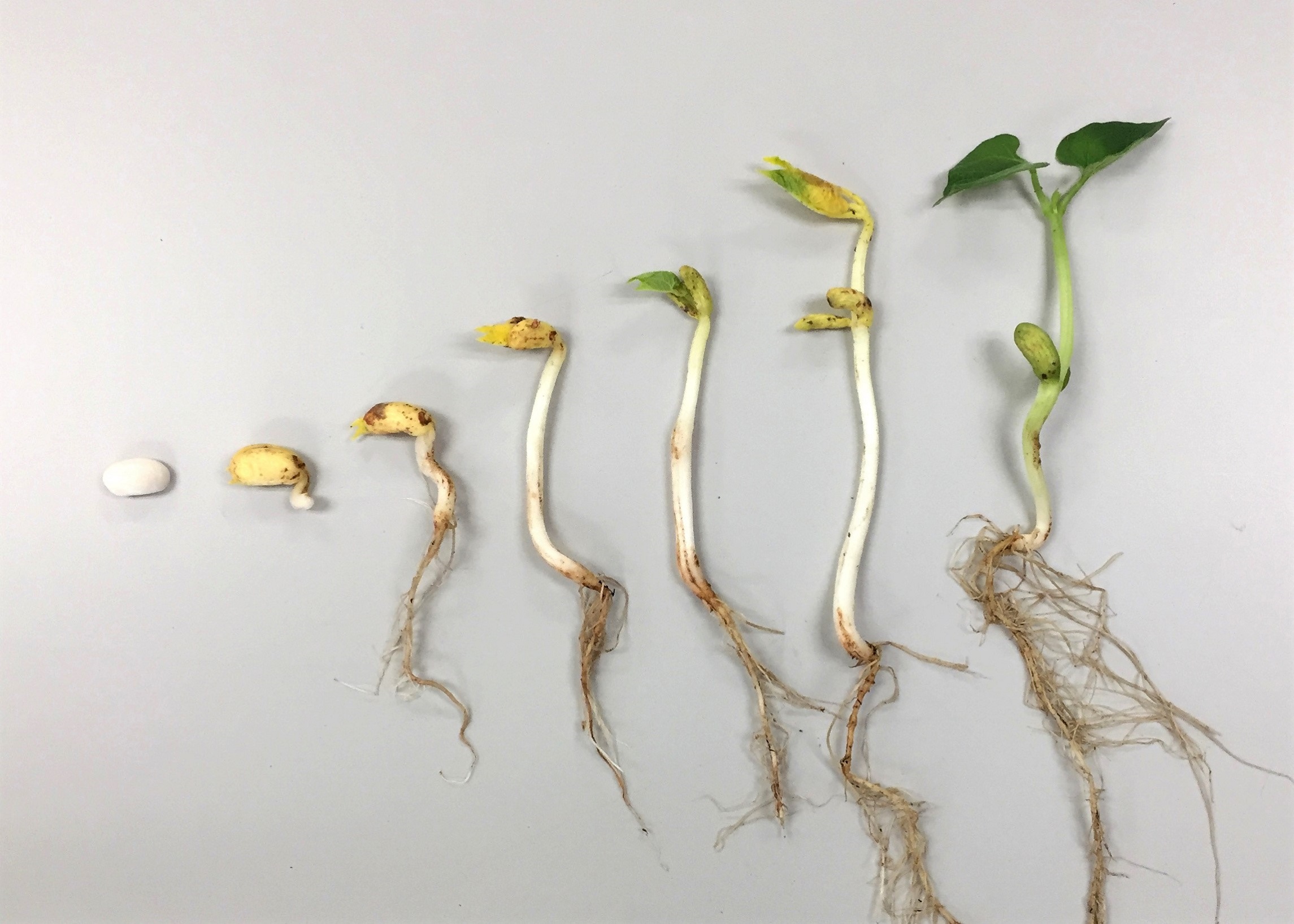
A seed already holds a tiny plant and its first meals. When a bean takes up water at the right temperature, its cells use oxygen to release energy from stored food. That gets the first root and shoot growing. In daylight, green leaves use light energy to make sugars from water and carbon dioxide. Those sugars supply fuel and material for new cells. As cells divide and expand, the roots reach farther and the stem grows taller.12345
What’s packed inside a bean?
Gently pull apart the two halves of a soaked navy bean. Look along the inside edge of one half for a pointed root tip and a pair of folded leaves. They belong to the embryo, a young plant that began growing inside its parent’s pod. Those two chunky halves are part of the embryo, too. They’re seed leaves, called cotyledons. They hold the food the young plant will draw on first.12
Now picture a whole, dry bean tucked into damp soil. It takes up water and swells. At a suitable temperature, the embryo resumes growing. Its cells use oxygen from air pockets in the soil to release energy from the food stored in those thick seed leaves. That return to growth is called germination. It can be well underway while the patch of dirt above the bean still looks empty.12
Which part pokes out first?
Imagine catching the moment a white tip first pokes through the seed coat. What would you guess it grows into? That little tip is the first root. It anchors the seedling and starts taking up water. The first green leaf is still tucked inside.27
Next comes the shoot. In a navy bean, a bent section of stem pushes up through the soil like the crook of an elbow. As it straightens, it lifts the two thick seed leaves into daylight. Between them, a pair of thin green leaves unfolds. For a while you can see both pairs on the same plant. Watch a pea sprout and you’ll see a different trick. Its shoot comes up while its food-filled seed leaves stay underground.267
How does a bit of air become part of a leaf?
By the time those green leaves spread out, the seedling has another way to feed itself. Carbon dioxide from the air enters through tiny pores in each leaf. The roots take up water and dissolved minerals, and narrow tubes carry water up the stem. In the leaves, a green pigment called chlorophyll captures light. Using that energy, the leaves make sugars from carbon dioxide and water. They also release oxygen. That’s photosynthesis.34
Now follow one carbon atom. It enters a leaf in a molecule of carbon dioxide and becomes part of a sugar molecule. The plant can send sugar to a new leaf forming at the tip of the shoot. There, cells can link units of a sugar called glucose into long chains of cellulose. Cellulose helps give each cell wall its strength. A carbon atom that once drifted past as gas can end up holding a leaf together.345
Where does the next inch come from?
Look between the two open leaves at the top of a young bean. The next leaf is taking shape inside that little bud. At the shoot tip, cells keep dividing. One becomes two. Just behind the tip, young cells take up water and expand. As those cells lengthen, so does the stem. Much the same thing happens near the tip of each root, extending its reach into the soil.35
Even down in the dark, a growing root gets sugar delivered from the leaves. Root cells use oxygen to release energy from some of that sugar and use some to build new cell walls. Later, the bean plant flowers. After fertilization, part of the flower grows into a pod, and the new beans inside it fill out. Pull apart one of those mature beans and you’re back where we started, with a tiny plant and its first meals already packed.12346