
With conventional Up and Down buttons, the controller knows where you’re waiting and which way you want to go. A car can pass your Down request while it’s still serving higher floors, then pick you up on the way back. With destination dispatch, you give the controller your exact floor before boarding, so it can factor your drop-off into which car it sends.12
Why an elevator can pass you going up
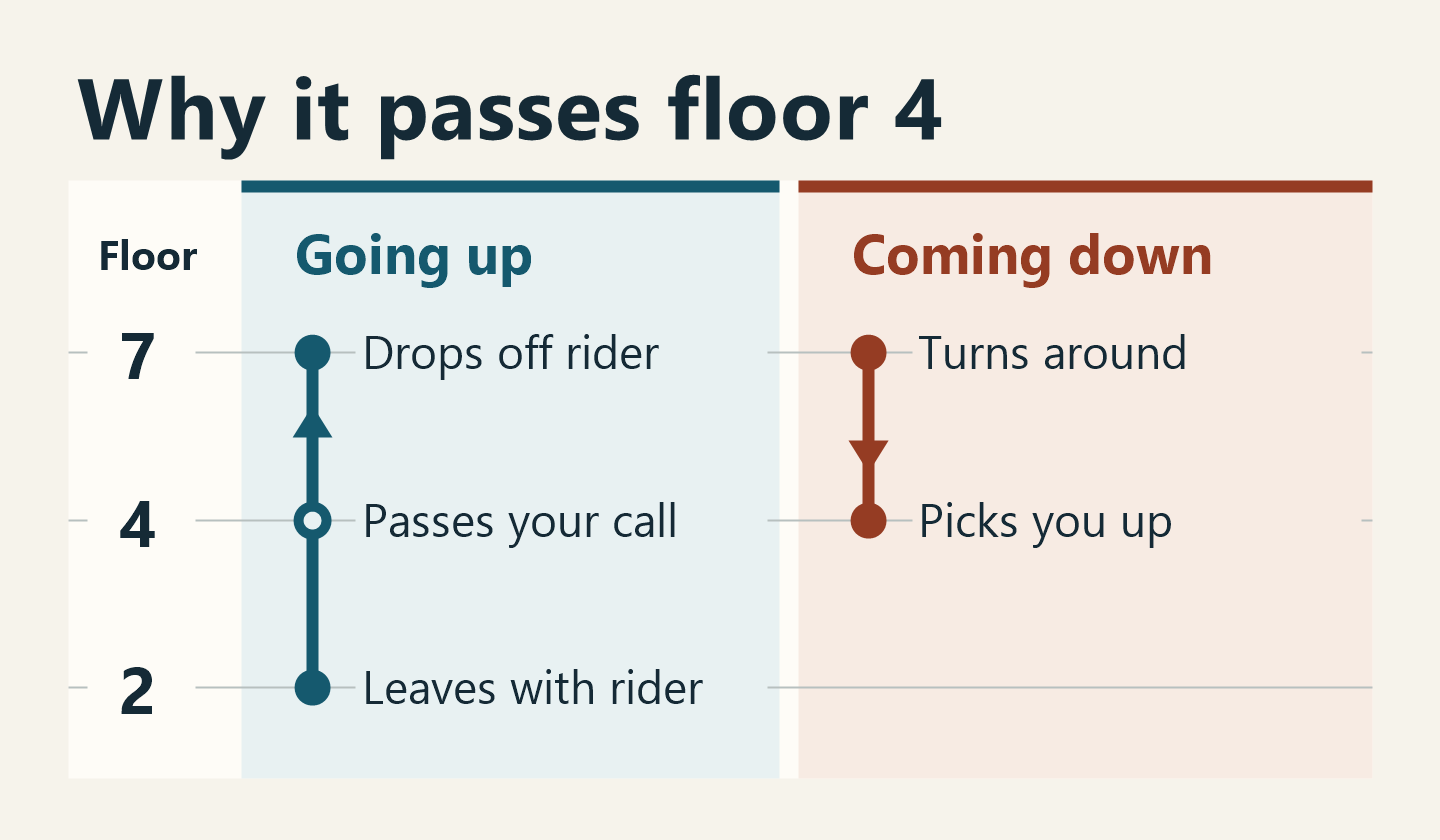
Imagine you’re on floor four, heading to the lobby. You press Down just as the elevator leaves floor two with a rider going to seven. You hear it pass. Your button told the controller that someone at four wants to go down. The floor button inside the car will tell it you’re going to the lobby.1
In a setup called selective collective control, the car serves its riders’ stops and picks up people heading the same way. It takes those stops in the order it reaches the floors, even if the buttons were pressed in a different order. In our example, the car keeps your Down request on its list, drops the rider off at seven, then reverses and picks you up at four. If you’d pressed Up, the same car could have picked you up on its way to seven.1
Which car gets your call?
So far there’s been one car. When several cars share a set of hall buttons, the group controller has another decision to make. Which car should pick you up? Some systems compare how far each car has to go and what stops are already on its route, then send the car they expect to arrive first. A car farther away and already coming down could reach you sooner than the one that just passed you, because the upward car still has to stop at seven and turn around.12
Choosing a car is called dispatching. Ordering that car’s stops is a separate decision. With one car, your pickup can wait until it comes back from seven. With several, the controller might send another car while the first one carries on upstairs.12
What changes when you enter your floor first?
At an Otis Compass 360 panel, you enter your destination before you get in. The screen tells you which car to take. Now the controller can work out where each candidate car would need to stop to pick you up and drop you off. That matters when the car already has people to deliver.23
Engineers from ThyssenKrupp and Peters Research worked through an example with three cars. A rider on seven enters floor two. Car one needs fifteen seconds of travel to get to seven, plus ten seconds to drop off someone at eight. After picking up the new rider, it takes another twenty-five seconds to reach two. That’s fifty seconds of waiting and riding for the new passenger. The rider getting off at eight is already out of the car before the new stop at seven, so their trip takes the same time.2
Why a five-second pickup can lose
Car three could pick up the new rider in five seconds and get them to floor two in another twenty-five. The catch is that eight people are already riding to floor one. Adding a pickup at seven and a drop-off at two costs those eight riders twenty seconds each. The controller adds those delays to the new rider’s thirty seconds of waiting and riding. That makes one hundred and ninety seconds in all.2
Car two scores fifty-five seconds. The new rider spends forty-five seconds waiting and riding, including a stop at six. Picking up the new rider adds ten seconds to the trip of the person getting off at six. So this controller chooses car one, with the lowest total at fifty seconds. If it were choosing by pickup time alone, car three would win. Different systems can weigh that trade-off differently. The point of entering your floor early is that the controller can account for your drop-off before it chooses your car.2