Does every life come with a purpose? Faith and philosophy offer different answers.12 Philosopher Susan Wolf asks a question closer to home. What makes a life meaningful? Her answer is that we find meaning when we give our time and care to someone or something worth caring about. That could be a person, a piece of music, or a question you’d gladly spend years trying to answer.3
Do we come with a purpose?
A spade is an easy case. Somebody made it for digging. Were we made for something, too? The Westminster Shorter Catechism, a text in the Reformed Christian tradition, opens by asking what human beings are here for. Its answer is to honor God and enjoy him forever. On that account, you can spend a lifetime discovering how to live out a purpose that was already yours.1
The philosopher Jean-Paul Sartre was an atheist. He saw no maker who had drawn up a plan for us. In his view, the things we choose to do help make us who we are.2 Think of a friend who says, “Call me anytime.” There’s an idea of friendship in those words. You learn a little more about it when the phone rings at two in the morning and your friend picks up.
What makes something worth doing?
Susan Wolf gives the example of staying up all night to sew her daughter a Halloween costume. Why lose sleep over an outfit that might get worn once? Because it’s this child, she has her heart set on being this particular thing for Halloween, and you know how to sew.3
For Wolf, two things come together here. You care how the costume turns out. And your daughter gets to go out into the world dressed as the creature she’s been imagining. Even someone who’s never threaded a needle can see why that’s worth doing. Wolf thinks making music or pursuing an idea can give a life meaning in much the same way. For Wolf, the work has value beyond the pleasure you take in it.3
How can you tell what feels meaningful to you?
Imagine a mother sewing a pair of dragon wings. She learned to sew at her grandmother’s elbow. By now she can pick out a crooked seam by touch. Tonight she’s using the same stitch on her daughter’s costume. There’s a thread she can follow from her own childhood to her daughter’s. Psychologists Frank Martela and Michael Steger call that sense of how the pieces of your life fit together coherence.4
Then there’s purpose. Ask her at midnight what she’s working toward and she can tell you exactly. This dragon needs wings by morning. Significance is the sense that your life is worth living.4 In the morning, her daughter slips her arms through the loops, takes a running start down the hall, and flaps. For her mother, getting to be here for that is part of the answer.
Those three ideas help explain what makes her life feel meaningful. They leave open the question of what the universe is for.4
Why did the gardener put down his spade?
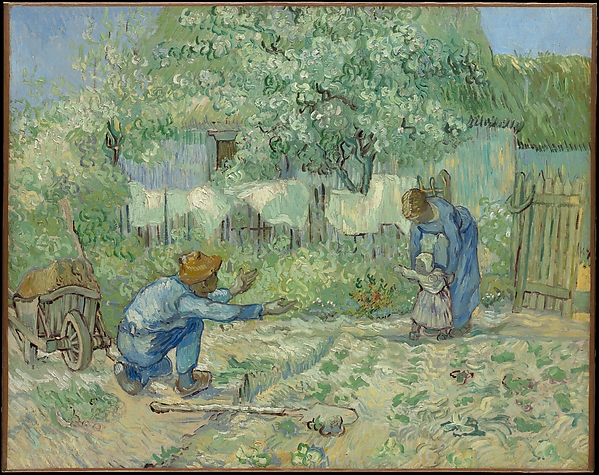
Look at the stretch of earth between the child and the kneeling man in Vincent van Gogh’s First Steps. There’s room for a wobble. The woman behind the child is still close enough to steady her. Van Gogh painted the scene in 1890. His brother Theo had sent him a photograph of an earlier work by Jean-François Millet. One artist saw something worth keeping in that little stretch of garden. So did another.5
What are we all here for? The people in that garden might have given three different answers, once the youngest could talk. But if you asked the man what he was there for just then, he could answer by holding out his hands.