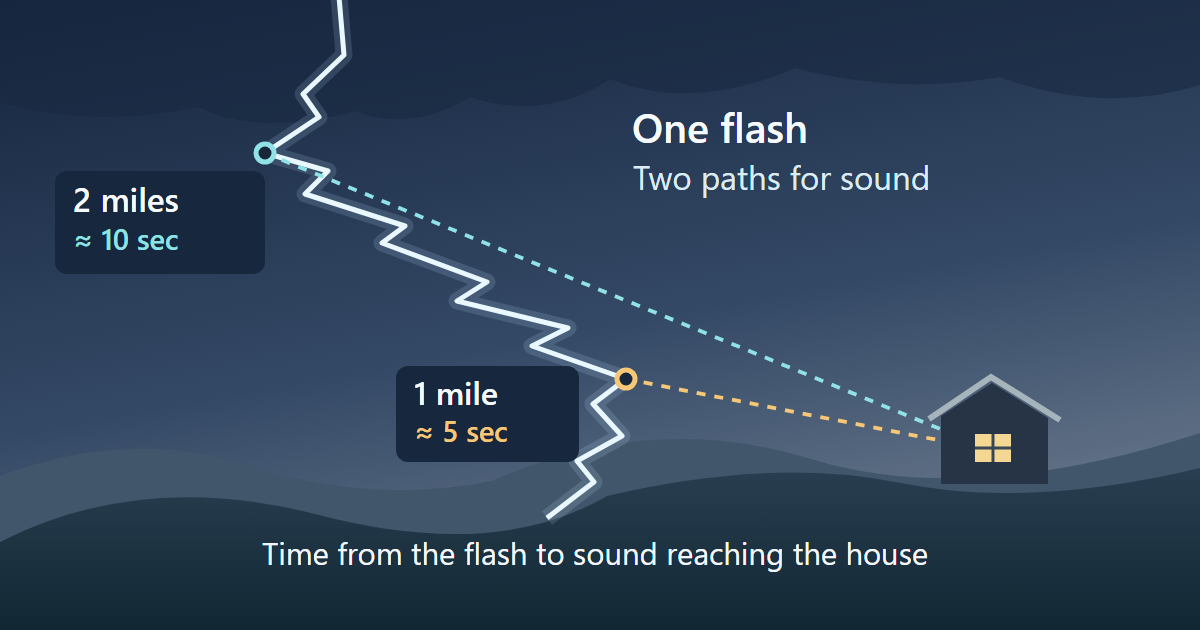
Light from a lightning bolt travels much faster than sound. The bolt heats the air along its path so quickly that the air expands and sends a pressure wave outward. You see the flash almost instantly. The wave takes about five seconds to travel a mile. Sound from more distant parts of the same bolt keeps arriving after the first crack. You hear it as a rumble.124
Where is the thunder during the quiet?
Picture the bright zigzag that lit up your kitchen. It traces the path an electric current took through the air. Scientists call that path a lightning channel. The current heats the air in the channel so suddenly that it expands and gives the air beside it a hard shove. That change in pressure travels outward as a wave. When the wave reaches your ears, you hear thunder.1
Light crosses a mile of air in a tiny fraction of a second. Sound takes about five seconds to cover the same mile. So by the time you see your shadow, the thunder is already on its way. During those quiet seconds, the pressure wave is still crossing the distance to your kitchen.2
Listen to two bends in the same bolt
It’s easy to picture thunder coming from the spot where lightning hits the ground. But the air gets that shove all along the channel, even high above the ground. Imagine one bend a mile from your kitchen and another bend two miles away. Both light up in the same flash. Which bend will you hear first?12
About five seconds after the flash, sound from the nearer bend reaches you. Sound from the farther bend arrives around the ten-second mark. What fills the seconds in between? Trace the stretch of channel connecting the two bends. Each bit heated the air and sent out its own pressure wave. Those waves have different distances to travel. As they reach your ears, their sounds overlap. That’s how one brief flash can give you a rumble that rolls on for seconds.124
Can you tell which part you heard?
In Florida, researchers lined up fifteen microphones to record lightning they triggered during a storm. Sound from each part of the channel reached the microphones at slightly different times. Comparing those recordings let the team trace the sound back to different heights. They pieced together a side view of the channel from thunder alone.3
Back in your kitchen, you can use the gap between the flash and the first thunder you hear to estimate a distance. A five-second gap puts the part you heard first about a mile away. Because the channel bends, that sound could have come from a stretch high above the ground. The count alone can’t tell you where the bolt touched down.12