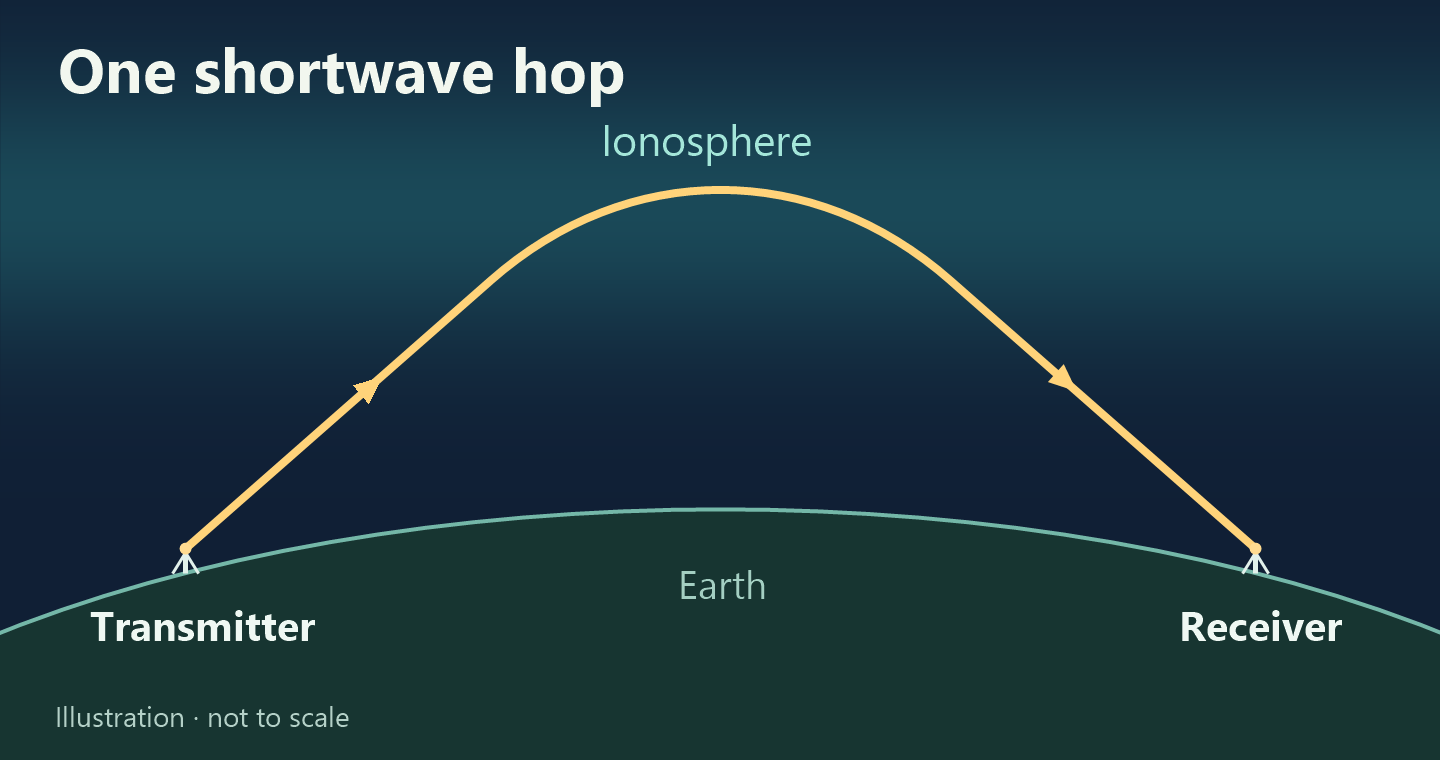
Earth’s upper atmosphere can steer a shortwave signal back toward the ground. Sunlight frees electrons in a region called the ionosphere. As a radio wave climbs at a slant into air where free electrons are more concentrated, the upper end of each wave crest pulls ahead. That turns the crest a little at a time. With the right frequency and angle, the signal curves back down to a listener beyond the horizon.23
One clock, several places on the dial
Imagine tuning a shortwave radio until you hear a steady tick. Then a voice announces the time and gives the station’s call sign, WWV. Its antennas stand near Fort Collins, Colorado. Separate transmitters send the same time signal on 5, 10 and 15 megahertz, each at 10,000 watts. All three frequencies fall in the high-frequency band, or HF, which runs from 3 to 30 megahertz.12
Now put your receiver so far from Colorado that Earth’s curve hides the tower. Stretch a straight line between the two antennas and part of it would run underground. Some of the radio energy leaves the tower at an upward slant. How does a signal headed into the sky reach the radio on your kitchen table?23
Follow one wave crest
High above the clouds, extreme ultraviolet light and X-rays from the Sun knock electrons loose from atoms and molecules. This region is called the ionosphere. A radio wave passing through it has an electric field that tugs the free electrons back and forth. Their motion changes how quickly the wave’s repeating pattern of crests advances through the gas.23
Picture two people walking side by side, carrying a long pole between them. If the person on your left takes a few quicker steps, that end swings ahead and the pole turns. Now imagine drawing a line along one radio crest as the wave climbs at a slant. Where the concentration of free electrons increases with height, the upper end of the crest advances faster than the lower end. The line turns, just as the pole did.3
The wave travels at right angles to that crest in this simple picture. So as the upper end swings ahead, the wave heads a little less steeply upward. Those small changes add up. The path can level out, then curve down toward the ground. Radio operators sometimes call that a bounce. The turn itself can be smooth across many miles of sky. That gradual bending is called refraction.23
Where the signal comes down
The whole time the signal was climbing and turning, it was also traveling away from Colorado. By the time it comes down to antenna height, it can be thousands of kilometers from the tower. If your kitchen radio is there, you can hear the ticks. A radio wave that reaches you by way of the ionosphere is called a skywave.12
Operators call one trip from the ground to the ionosphere and back a hop. Some of the returning energy can reflect off land or ocean and head skyward again. A second hop can carry those same ticks beyond yet another horizon.2
Which frequency carries the ticks after sunset?
Suppose you heard WWV on 15 megahertz this afternoon. Will the same spot on the dial work tonight? For waves entering at the same angle, the higher frequency generally bends less. Angle matters, too. A signal headed steeply upward has farther to turn before it levels out than one already traveling at a shallow angle. If the electron concentration along its path never gets high enough to turn it back, the signal continues into space.23
As darkness spreads along the route, free electrons gradually rejoin other particles. High up, in the F region, that can leave too few to turn the 15-megahertz signal back toward your radio. Something else happens lower down. In daylight, the signal passes through a region called the D region on the way up and again on the way down. It absorbs some of the radio energy, especially at lower frequencies. After dark, that absorption usually eases.24
So if the ticks fade on 15 megahertz, try tuning down to 5. You might hear that familiar voice from Colorado again. The station has been keeping time all along. What changed up in the sky was which frequency could carry it to you.12