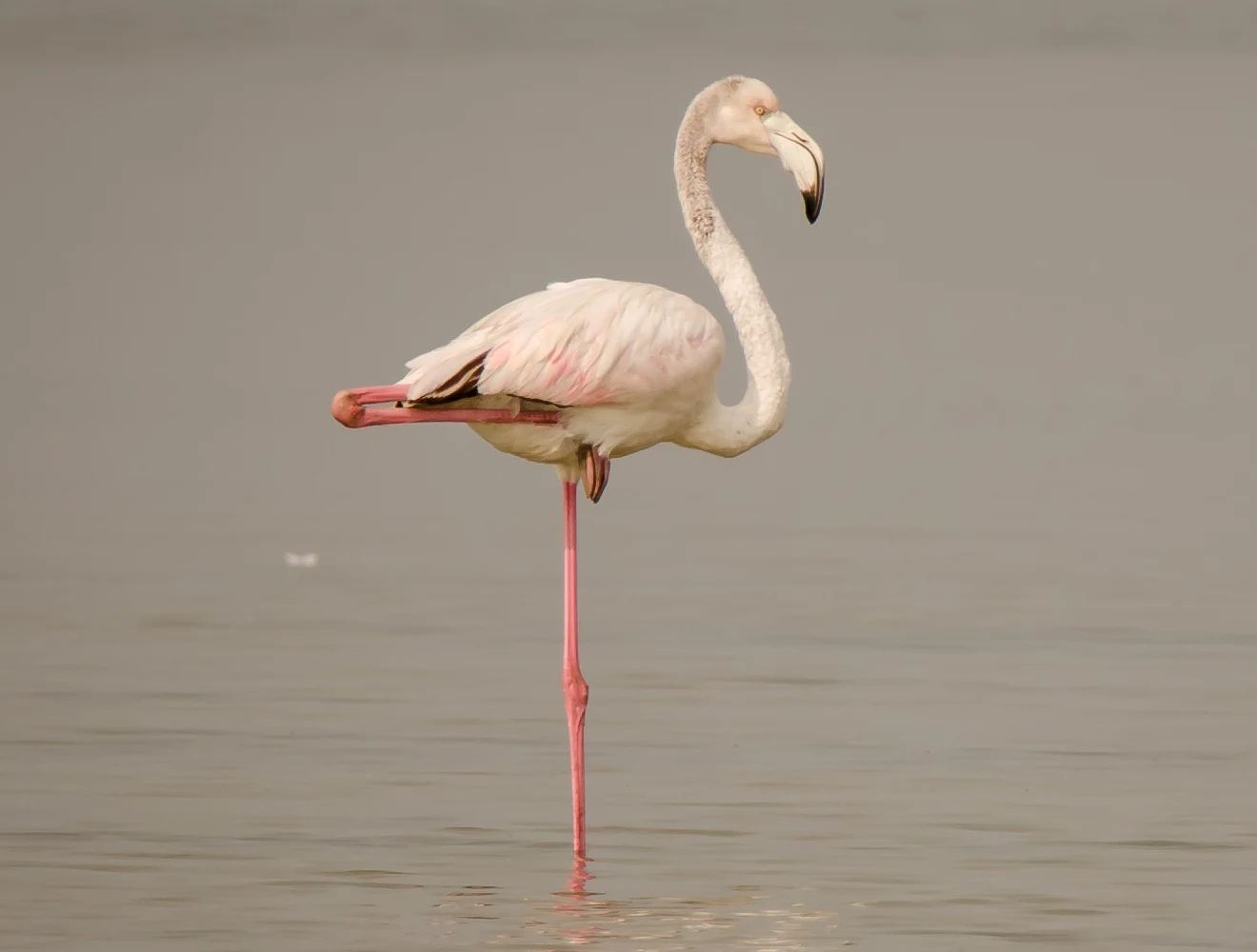

A flamingo’s own weight helps steady the leg it stands on. With the foot under the middle of its body, gravity pulls the hip and knee against limits built into the joints.1 Tucking the other leg may help the bird hold on to heat.234 How much energy a live flamingo uses in the pose is still open.1
One foot under the body
Try lifting one foot. As you shift your weight over the foot on the floor, you may feel your ankle make little corrections. A resting flamingo brings its standing foot inward from the hip, under the middle of its body. In that position, the bird’s weight pulls down in front of the knee and turns both the hip and knee toward the limits of their motion. Those limits brace the joints so the leg can bear the bird’s weight with little active muscle force.1
Think of a door pushed open against a doorstop. The stop keeps the door from swinging any farther. In the flamingo’s leg, the joints have limits like that, and the bird’s own weight supplies the push. Researchers tested the idea with two dead Caribbean flamingos, clamping a lower leg to a stand. When the leg angled inward, as it does in the one-legged pose, the hip and knee supported the body without any muscle contractions. When the researchers moved the leg outward to mimic its position in a two-legged stance, the joints gave way in the test setup.1
How much work does a live bird do?
The researchers also watched eight young Chilean flamingos on a force plate, a platform that measures the forces where a bird presses on the ground. On one leg, the birds swayed less when resting with their eyes closed than during more alert activity. In the quiet pose, the ground’s upward push stayed almost directly under the joint at the base of the toes. A force that lines up with a joint has little leverage to twist it, leaving less for the muscles around that joint to counter.1
The team measured joint motion in the specimens and forces at the feet of the live birds. It did not measure how much energy the living flamingos used on one leg or two. A leg that bears weight with little muscle force makes an energy saving plausible. The full cost of the pose would also include whatever effort it takes to hold the other leg up.1
What about the leg it tucks away?
Tucking one leg into the feathers leaves less bare skin exposed to air or water that can carry heat away. In one study of captive Caribbean flamingos, a larger share rested on one leg in water than on land. That share fell as the temperature rose.2 At a zoo in Japan, researchers pointed a thermal camera at ten flamingos as they switched legs. The tucked leg was warmer on average when it came out, and the birds held the pose longer during the cooler autumn observations. The camera measured the legs’ surface temperature, leaving open how much heat the whole bird saved.3
The temperature pattern varied across studies. At a wetland center in England, researchers watching five captive species found that the birds spent longer on one leg in water and inside their housing. Air temperature was among the factors they tested, but it didn’t make the best model of the birds’ behavior.4 Taken together, the studies show how the bird can support its weight on one leg and shelter the other from the cold. How much each benefit matters when a flamingo settles down is still open.1234