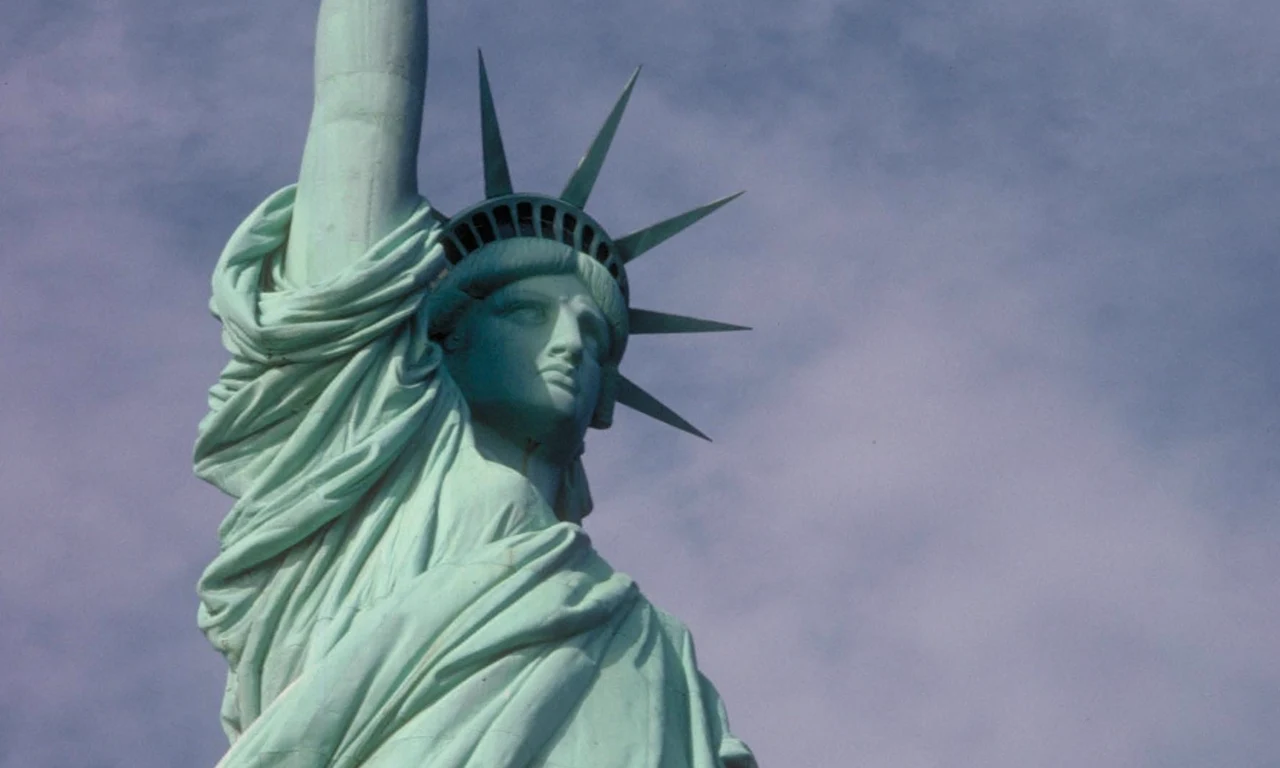
The green comes from the statue’s own copper. Over decades in the harbor air, some of the copper at the surface reacted to form minerals. This mineral coating, called a patina, clings to the copper sheet underneath. It slows the rate at which the remaining metal corrodes.12345
A face the color of a penny
Picture the folds of Liberty’s robe in the color of a copper penny. That’s how she would have looked at her unveiling in 1886. By 1906, the National Park Service says, the copper had taken on its familiar sea-green color.12
What changed in those twenty years? Oxygen reacted with copper at the surface to form copper oxide. As the copper weathered, acidic moisture on the surface helped other minerals form, including green copper sulfates. The name for that coating is patina. Its color tells you something about what the metal has been exposed to.237
What’s in a fleck of green?
During the 1980s restoration, two researchers used X-rays to identify minerals in samples from across the statue. The main one they found was brochantite, a green mineral that contains copper, oxygen, hydrogen and sulfur. Some of the copper that once gave the robe its penny color is now part of the mineral that makes it look green.3
Two pieces of the statue gave the researchers a clue about the order of events. One piece of copper skin had been removed in 1905, the other in 1980. Both carried copper oxide that appeared to have formed before the green minerals. By the time anyone could see a green patch on Liberty’s sleeve, the copper at the surface had already begun to change.3
Why leave the green where it is?
Imagine polishing one fold of that sleeve until you could see shiny copper again. Oxygen could reach the freshly exposed metal directly. Now move one fold over. There, the minerals still cling tightly to the surface, making it harder for oxygen to reach the copper sheet underneath. That copper corrodes more slowly. Leaving the patina in place helps preserve the very metal it grew from.45
Inside the statue, restorers found a different story. Iron bars supported the copper skin, with insulating material between the two metals. In places that insulation had broken down. Where iron and copper touched and salty moisture reached them, a tiny electric current could flow, much as it does in a battery. The iron corroded. That’s how Liberty could have a protective coating on the outside and still need repairs behind the folds of her robe.6