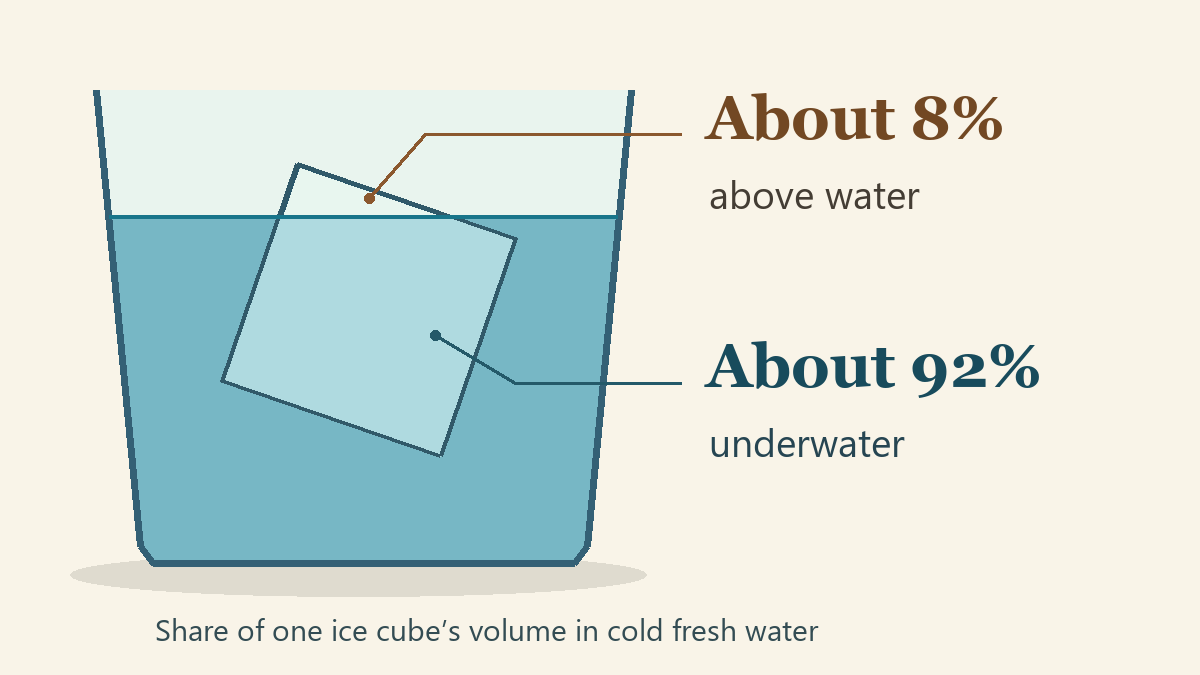
Water expands when it freezes. The same molecules settle into an open crystal pattern, so a cube of ice weighs less than an equal volume of liquid water.12 About nine-tenths of an ordinary cube needs to sit below the surface of fresh water to push aside water equal to the cube’s own weight. That’s enough to support the whole cube, tip and all.34
What changed in the ice tray?
Weigh a spoonful of fresh water, then freeze it in an ice tray. As long as none spills or evaporates, the ice has the same mass you started with. Put it on the scale and you get the same reading. What changes is the space that spoonful takes up.12
In liquid water, molecules slide past each other and keep changing neighbors. Attractions called hydrogen bonds tug neighboring molecules toward one another.5 When water freezes, those bonds hold the molecules in a repeating pattern with open spaces between them. The same spoonful now takes up more room. That gives you two ways to picture density. The same mass fills more space as ice. Or, if you compare equal volumes, the ice weighs a little less than the liquid water.12
What happens when you let go of the spoon?
Now put your cube in a glass of cold fresh water. Hold it just below the surface with a spoon. The water level rises because the cube takes up space where water used to be. The amount of water it pushes aside is just enough to fill that space. That’s what it means to displace water.3
Water presses against the cube from every side. That pressure increases with depth, so the water pushes harder on the bottom of the cube than on the top. Add up all those pushes and you get a lift called buoyancy. The lift equals the weight of the water the cube pushed aside.3
Think back to those equal volumes. A cube held completely underwater pushes aside a cube’s worth of water. That water weighs more than the ice, so the lift is stronger than gravity’s pull on the cube. Take the spoon away and up it comes.23
Why does so little ice stick out?
As the tip breaks the surface, less ice is underwater. The cube pushes aside less water, so the lift gets weaker. Once the bobbing stops, the displaced water weighs exactly as much as the whole cube. The upward push and the downward pull of gravity balance.3
Say your cube takes up ten milliliters of space. On a scale it reads about nine point two grams. In cold fresh water, nine point two milliliters gives you the same reading. So just over nine of the cube’s ten milliliters have to be underwater to displace that much water. That leaves less than one milliliter of ice peeking out. The exact fraction can change with air bubbles in the ice, but for ordinary ice in fresh water, roughly nine-tenths of its volume sits below the surface.234