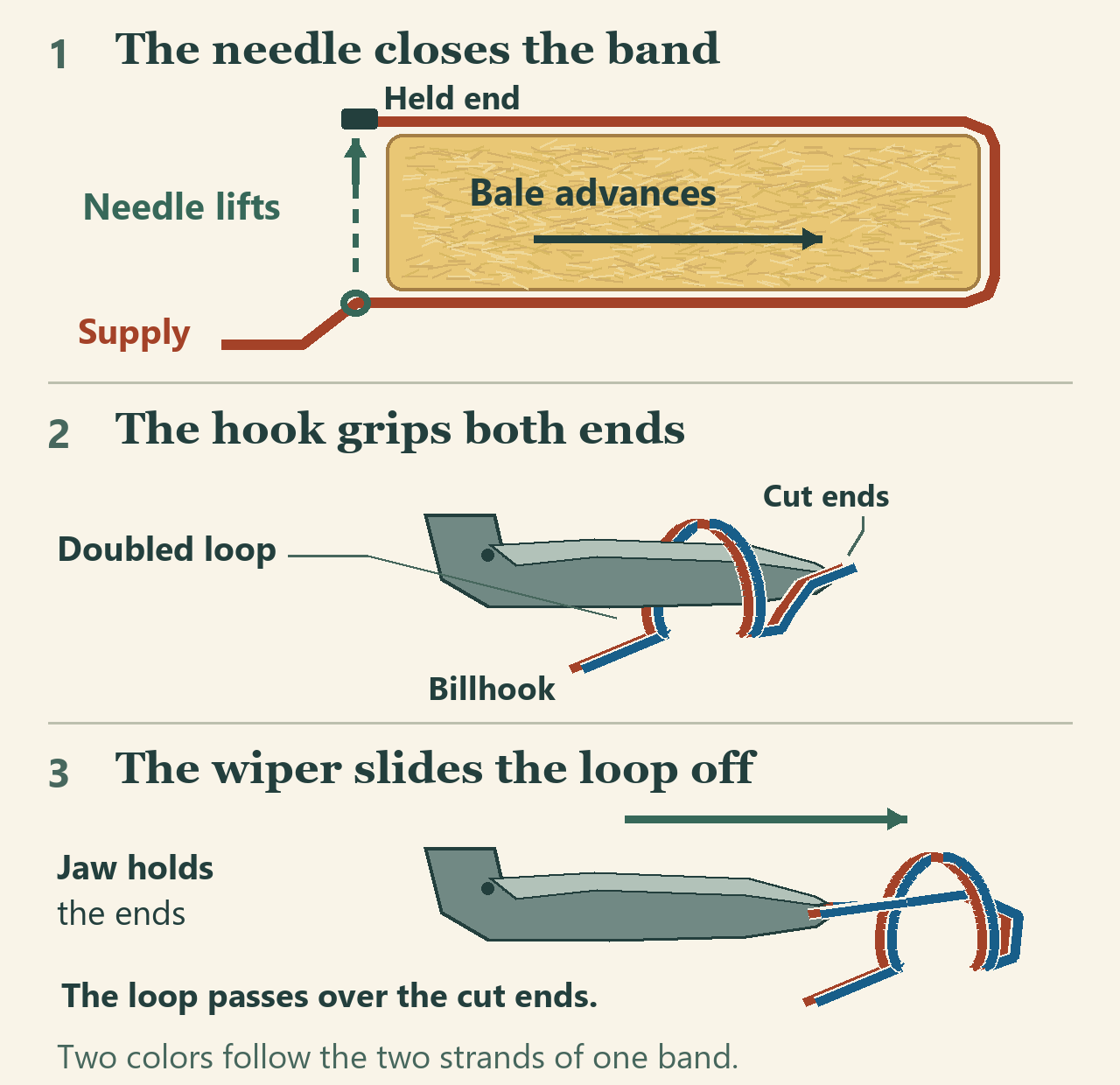
On a twine-tied small square baler, a curved needle delivers the twine and a rotating hook ties the knot. The needle brings one strand up beside the end the machine already holds. The hook, called a billhook, winds both strands into a loop and grips them in its jaw. A knife cuts the strands. A wiper slides the loop off the hook and over the two cut ends, pulling them through to complete the knot.1234
Where does the first end go?
Picture a small rectangular hay bale with two bands of twine running lengthwise around it. Each band has its own knotter. Let’s follow one of them, starting with the end of the twine held in a slotted disk above the bale chamber. From there, the twine hangs across the path of the incoming hay, passes through the eye of a curved needle below the chamber and runs back to a ball of twine in a box.12
The baler picks up hay from a row in the field. A plunger packs each new mouthful against the one before it and pushes the growing bale toward the outlet. Imagine pushing a brick sideways into a hanging string. The string folds around the brick as it moves. The hay does much the same thing. It carries the twine along and draws more from the box. By the time the bale is long enough to tie, the twine covers the top, the end nearest the outlet and the bottom. Which side is still open?12
The needle closes the fourth side
The open end faces the plunger. The needle is waiting just below it. A toothed measuring wheel turns as the hay moves past. When the bale reaches the chosen length, the wheel trips the tying mechanism. The needle swings up across that last end, carrying the twine in its eye.12
At the top, a metal guide called a tucker finger helps lay the arriving strand beside the one that was already there. Both now lie across the billhook, a bent metal hook with a little jaw at its tip. The disk holds the strands in position. Trace the long way from one to the other and you go all the way around the hay. Right here at the hook, they’re close enough to pinch together.123
How do the ends get through the loop?
The billhook turns once. As it turns, the two strands wind side by side around the outside of the hook, making a small loop. The jaw opens and catches both strands. As the jaw closes, a knife on a swinging arm cuts the twine between the hook and the disk. At that instant the loop is on the outside of the hook, and both cut ends are pinched in its jaw.234
Imagine a loose loop of string around two fingertips, with the ends pinched between them. Keep pinching and slide the loop off over your fingertips. Where did the ends go? Right through the middle. A metal wiper on the knife arm does that same sliding motion. The jaw holds the ends while the wiper pushes the loop past them. The loop draws tight, the knot slips free, and one band now holds the hay.134
Who holds the string for the next bale?
Think back to the cut. The finished bale gets the knot. The disk keeps hold of the twine that still leads to the box. As the needle swings home underneath, it leaves a fresh strand stretched across the chamber. The next mouthfuls of hay press into it and push the tied bale toward the exit. By the time you see that first knot out in the field, the next bale is already wrapping itself.124