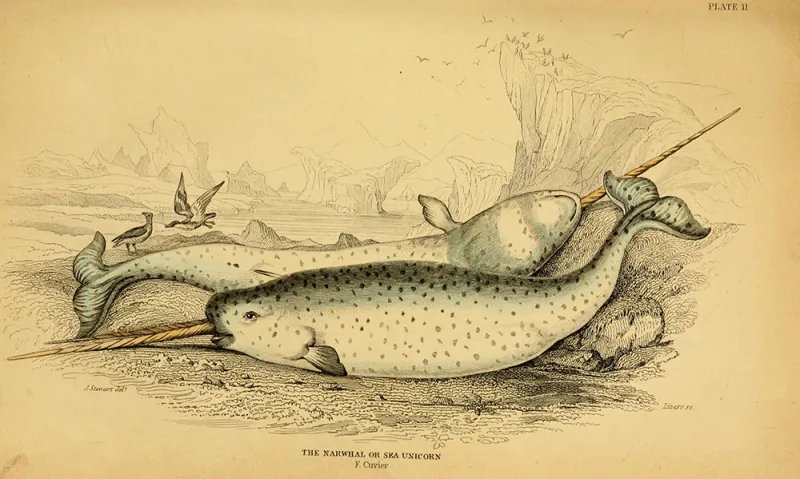
Yes—some narwhals grow two tusks. Most males have one long, spiraling tusk. Occasionally, a second develops beside it. Two-tusked narwhals are real, rare, and documented in museum collections.1
Where does the second tusk come from?
The familiar narwhal tusk grows from a tooth in the upper jaw. Usually, the left tooth extends outward while its partner on the right stays embedded. In a two-tusked narwhal, the right tooth grows out too.2
So the second tusk doesn’t appear from nowhere. It develops from a tooth that would ordinarily remain hidden.
How rare is it?
Rare enough to attract scientific attention, but it’s worth being careful with a neat worldwide percentage.
A 2025 scientific paper cites Greenland data in which two tusks occurred in approximately 0.9% of individuals—roughly one in a hundred in that dataset. That gives us a useful sense of scale, rather than a precise count for every narwhal population.3
Do female narwhals have tusks?
Most females keep both tusk teeth embedded in the upper jaw. Occasionally, a female grows a visible tusk. Males can also lack a visible tusk, so the familiar picture of “males have one, females have none” has exceptions.2
What is a tusk actually for?
Scientists associate the tusk with social and mating roles, including signaling status among males. Research also points to sensory functions and use in handling prey. A single explanation doesn’t capture everything this remarkable tooth may do.2
Having two raises another question: does the extra tusk change how a narwhal feeds?
A 2025 study examined chemical signatures in bone that offer clues about long-term feeding. Eight of the nine two-tusked males tested fell within the normal range for narwhals from their source regions. That small sample suggests an extra tusk doesn’t necessarily mean a dramatically different diet. It doesn’t settle whether two tusks affect every aspect of daily life.3
Is it a different species?
No. Scientists study two tusks as an unusual variation in narwhal tooth development, rather than a separate kind of whale. The extra tusk makes an already distinctive animal a little more extraordinary.3