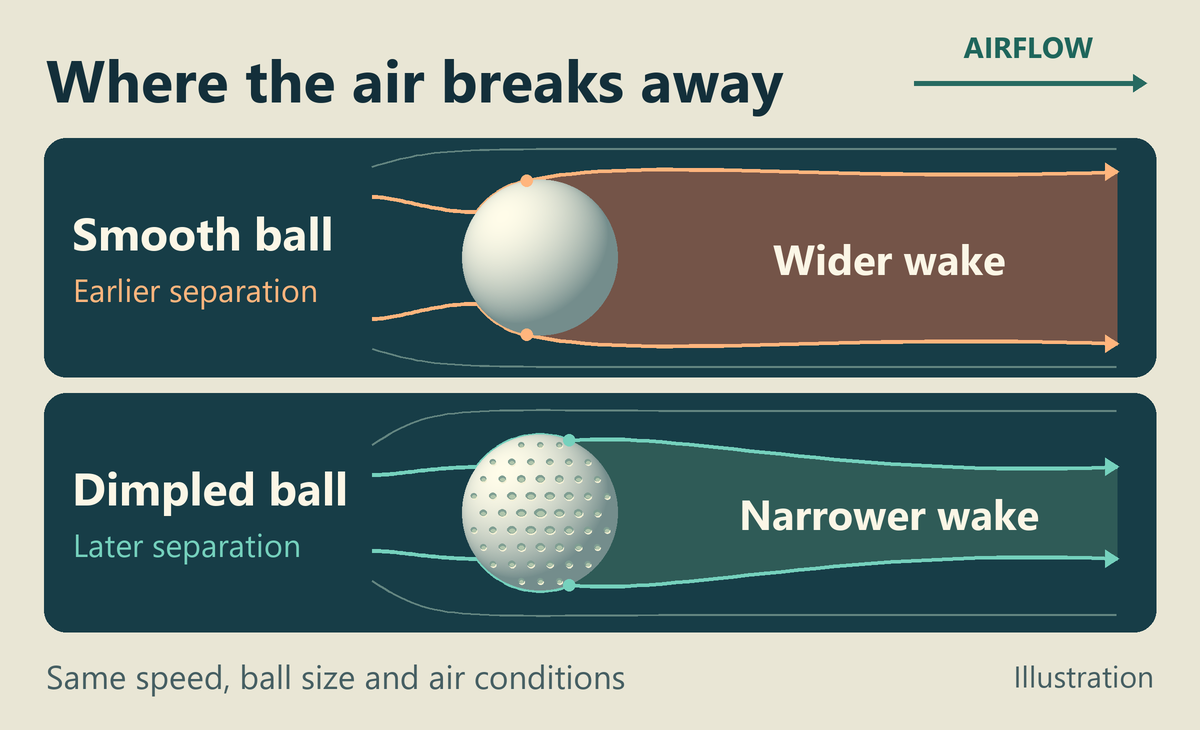
Dimples can help a golf ball fly farther by cutting drag. At the right speeds, they stir up the thin layer of air next to the surface so it follows the ball farther around. That shrinks the wake and reduces the backward force from the air.12
Where the air lets go
Picture two balls of the same size, tested one at a time in a wind tunnel. One is smooth and the other has dimples. Both stay still while air blows past them at the same speed. The air splits at the front and sweeps around the sides. Friction slows the air closest to the surface. That thin region is called the boundary layer.13
On the smooth ball, the slow-moving air rounds the side and encounters rising pressure. At the speed we’re comparing, it loses enough momentum that the flow peels away early. That leaves a broad wake of disturbed air behind the ball. The pressure stays low at the rear, so the air pushes backward on the front harder than it pushes forward on the back. The resulting backward force is called pressure drag.123
A little turbulence shrinks the wake
Now follow the air around the dimpled ball. At the same speed, the flow can briefly lift off over individual dimples and rejoin the surface. The disturbance makes the boundary layer turbulent. Faster air from just outside the layer mixes in, giving the air close to the ball more momentum to keep moving into the rising pressure. The main flow peels away farther back, leaving a narrower wake.12
That mixing can increase skin friction, the drag from air sliding along the surface. But with the flow attached farther back, pressure has more room to recover on the rear of the ball. That shrinks the difference in pressure between front and back. When the drop in pressure drag outweighs the extra resistance near the surface, the ball feels less total drag and can lose speed more slowly in flight.12356
Why speed changes the result
Turn the wind tunnel fan down far enough and the flow can peel away early from both balls. Turn it up and the boundary layer on the dimpled ball becomes turbulent first. In one wind-tunnel study, the researchers compared their dimpled model with published measurements for a smooth sphere. Over part of that range, the dimpled model’s drag coefficient, a standard measure for comparing drag, was about half as large.124
Turn the fan up farther and even the smooth ball’s boundary layer can become turbulent. The flow on the smooth ball can now stay attached farther back, too. Once both have made that transition, the dimples’ own resistance can leave the dimpled ball with more drag. The speed range where dimples help depends on the size of the ball, the properties of the air and the shape and depth of the dimples.1245