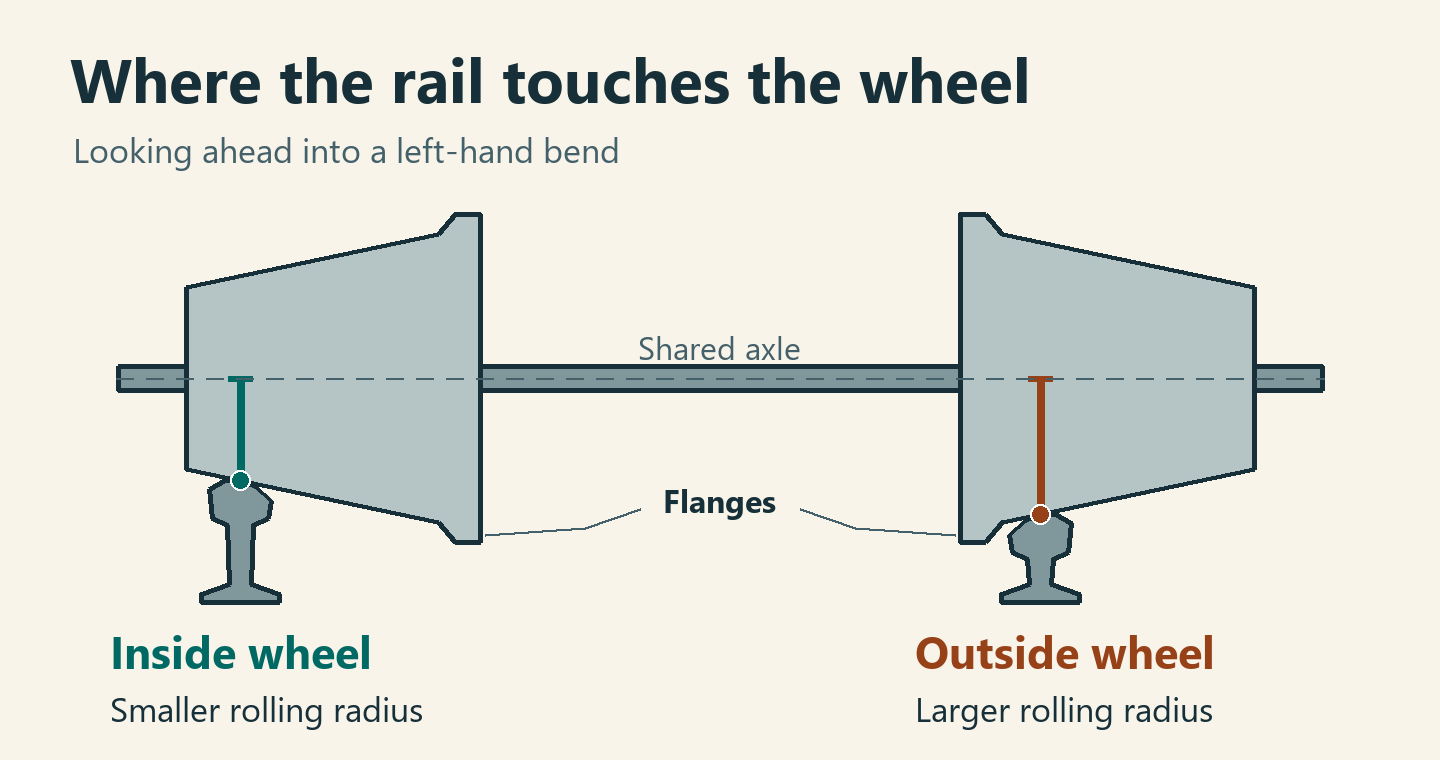
The shape of the wheels helps steer the train. On a conventional axle, both wheels turn together. As the leading pair enters a bend, it shifts slightly toward the outside rail. The outside wheel then rolls on a larger circle of its tread and covers more ground each turn. The inside wheel rolls on a smaller circle and takes the shorter path. On a tighter bend, a raised lip called the flange can press against the rail and help guide the wheels.12
Why does a paper cup roll in a circle?
Lay a tapered paper cup on its side and give it a gentle roll. Watch the wide rim sweep around the narrow base. Both ends complete each turn together. Now imagine wrapping a piece of string once around each end. Lay the two strings flat and the one from the rim will be longer. The difference in their lengths tells you how much farther the rim rolls in a single turn, which is why the cup curves toward its base.
Now picture a train entering a left-hand bend. The right rail takes the longer path, like the outside lane on a running track. But the two wheels on a conventional axle are fixed to it. Turn the left wheel once and the right wheel turns exactly once, too. Where does the right wheel find its extra length of string?1
Where does each rail touch its wheel?
The strip of steel that rolls along the top of the rail is called the tread. Look across its width and you’ll see a gentle slope. Picture drawing chalk rings side by side around the wheel. Near the middle of the axle, where the wheel has a larger diameter, a chalk ring runs a little longer. Toward the end of the axle, the rings get shorter.12
Follow the leading pair of wheels into that left-hand bend. The wheels tend to keep rolling straight as the track bends away, so the pair shifts a little to the right relative to the rails. Now the right rail touches the right wheel closer to the middle of the axle, on a longer chalk ring. The left rail touches the left wheel farther from the middle, on a shorter ring.1
Watch what happens over one turn of the axle. The right wheel rolls out its longer ring and gains a little ground on the left. That turns the pair to the left, just as the cup turns toward its narrow base. On a gentle bend, those two rolling distances can match the lengths of the rails closely enough for the wheels to follow the curve with their raised lips clear of the rail sides.12
What happens on a tighter bend?
That raised lip on the inner edge of each wheel is called a flange. It hangs down beside the rail, in the space between the two rails. Normally there’s a little gap between the flange and the rail. That’s what gives the pair room to shift sideways and roll on different parts of the treads.12
The tighter the bend, the more ground the outside wheel needs to gain with each turn. The tread is only so wide, and the suspension limits how freely the axle can swing into the curve. Follow the same pair a little farther to the right and the gap closes. The right wheel’s flange meets the inside face of the right rail. The rail pushes the wheel back toward the left, helping guide the train around the bend.12