Rivers carry dissolved salts from rocks on land to the sea. A freshwater river carries only a little salt in each bucketful, but it keeps delivering more. When ocean water evaporates, the salts stay behind. Hot water circulating through the seafloor also changes which minerals are dissolved in the ocean.123
How can a freshwater river deliver salt?
Rain picks up carbon dioxide from the air and becomes slightly acidic. As that water flows over and through rock, it can dissolve minerals and carry away tiny charged particles called ions. Streams feed those ions into rivers. Even a river with so little dissolved salt that it tastes fresh carries some to the coast.12
At the ocean surface, the water and its dissolved salts part ways. Water can evaporate, form clouds and fall again as rain. The salts stay in the sea. You can see the same thing in a shallow dish. Let a little seawater dry out, and the salts it carried will be left on the bottom.3
How much salt is in a kilogram of seawater?
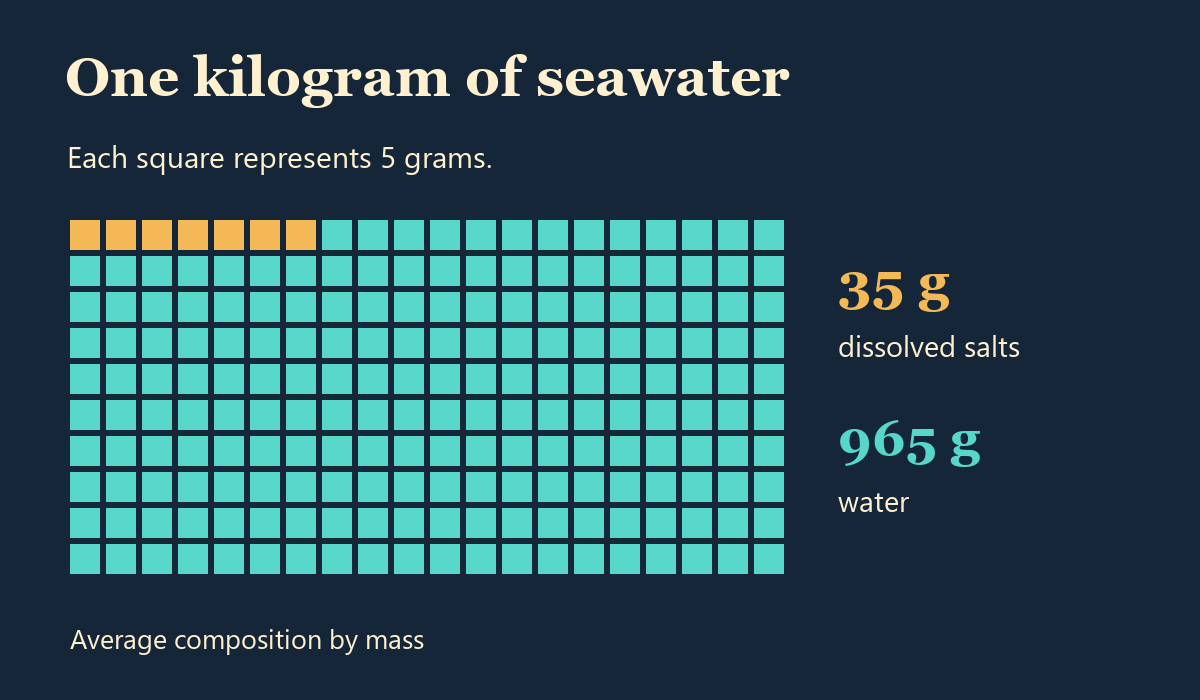
Set a bowl on a scale, zero it, and pour in one kilogram of seawater. At average ocean salinity, about 35 grams of what you just weighed is dissolved salts. The remaining 965 grams is water. That’s what 35 parts per thousand means here.1
Sodium and chloride, the ions that make up ordinary table salt, account for most of those 35 grams. The rest includes magnesium and sulfate. Where you fill the bowl matters, too. Rain can dilute the surface water, while evaporation leaves the remaining water saltier.1
What happens to salt at the seafloor?
Seawater seeps into cracks in the ocean floor. As it heats up and reacts with the rock, some of its dissolved magnesium stays in the rock. Iron can make the opposite trip, dissolving into the water. By the time the water flows back out through a vent, its chemistry has changed.12
Marine organisms also take up some of the ions dissolved in seawater. So the salt in our bowl tells a longer story than the journey downriver. Its mix reflects both what reaches the ocean and what living things and seafloor rocks take back out.12