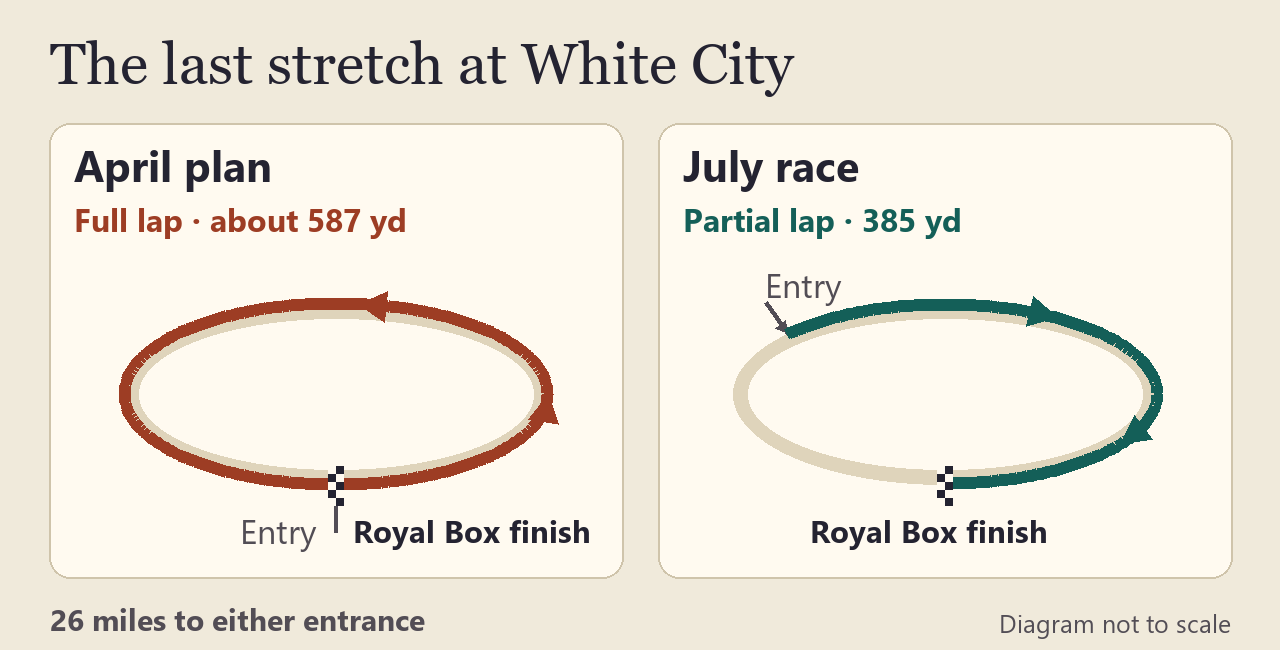
The modern marathon took its length from the 1908 London Olympics. Runners covered 26 miles from Windsor Castle to the track at White City Stadium, then 385 yards to the finish by the Royal Box. The international athletics federation adopted that distance in 1921. Today’s standard is 42.195 kilometers, or about 26.2 miles.1234
How did the course reach 26 miles?
For the 1908 London Olympics, the organizers started with a target of about 25 miles, roughly the length of the first modern Olympic marathon in Athens in 1896. Early marathons varied in length, so the organizers could adapt the course to the roads and stadium they had.24
One early route began near Queen Victoria’s statue in Windsor and measured about 25 and a half miles. A start near the East Lawn inside Windsor Castle’s grounds would add about 700 yards before the runners reached the statue. The organizers also added a detour near the stadium after objections to the original route. By the April trial, the plan called for about 26 miles just to reach the track.2
Where did the last 385 yards come from?
Picture yourself beside the Royal Box, the seats reserved for royalty. Under the April plan, you’d see the runners reach the track right below you after 26 miles. Then they’d run a full lap, about 587 yards, and come back to finish in front of you.2
On race day, you’d have the same seat and the same finish line, but you’d see the runners enter across the stadium. The organizers adjusted the approach to keep it at 26 miles. The runners took the track in the opposite direction, with about two-thirds of a lap left. The official report puts that stretch at 385 yards, for a total of 26 miles and 385 yards. Olympic historian Bob Wilcock found the plans documenting the switch, but no announcement explaining why the entrance moved.12
What about the royal nursery?
World Athletics tells a story about moving the start so royal children could watch from a nursery window. Wilcock found a November 1907 report in The Sporting Life saying the organizers were seeking permission to start on the castle grounds. In April, the plans already put the start near the East Lawn and still called for a full lap at the stadium.23
On race day, newspapers described the royal party arriving by carriage and put the children outside at the start. Wilcock found no contemporary evidence of a nursery request. The course plans account for both changes in distance. The start inside the castle grounds helped bring the approach up to 26 miles. The new path along the track supplied the 385 yards.125
When did London’s distance become the rule?
London’s course supplied the number. The rule came later. Stockholm’s Olympic marathon in 1912 covered about 40.2 kilometers. Antwerp’s in 1920 was longer, at 42.75. In 1921, the international athletics federation, then called the IAAF, adopted 42.195 kilometers as the standard. Paris ran that distance at the 1924 Olympics. The Olympic Museum says the federation’s records give no reason for choosing London’s distance.34
That’s 42 kilometers and 195 meters today. London’s 26 miles and 385 yards convert to almost exactly that. The standard comes to about 26.219 miles. Round it to one decimal place and you get the number you see on race signs, 26.2 miles.167