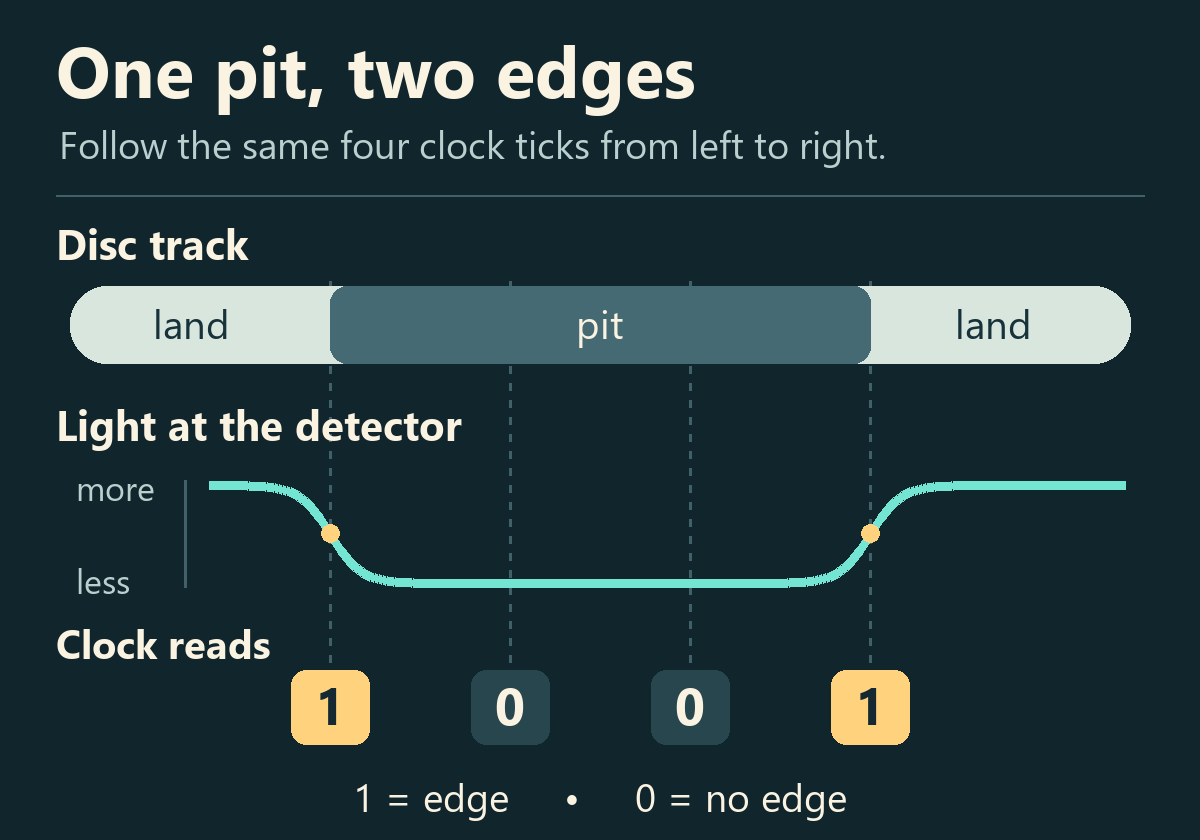
A CD or DVD player shines a laser on a spiral track and reads the changing brightness of the reflection. Either edge of a pit marks a one in the disc’s reading code. A clock tick without an edge gives a zero. On an audio CD, the player decodes those patterns into sound samples. A converter and amplifier turn the samples into a signal that moves a speaker. A DVD packs finer marks closer together. For a movie, the player separates picture from sound and uses timing marks to play them together.123456
Where is the click on the disc?
Listen to the first click of a drummer counting in the band. On vinyl, the groove moves a needle as the sticks meet. Put a pressed audio CD in the tray and a tiny spot of light reads the same moment. If you could stop the disc right there, what shape would you expect to find?9
Under the clear plastic, a spiral runs through a reflective layer. Shallow marks along the spiral are called pits. The flat stretches between them are called lands. As the disc turns, the pickup keeps a tiny spot of laser light focused on the track. Stop anywhere in the middle of that click and you’ll find pits and lands of different lengths. The recording of the click is spread across many of them.128
What does one pit look like to the player?
Start on a stretch of land. Plenty of light comes back to the detector. Now a pit slides into the spot. The spot is wide enough to cover both the pit and the land beside it. Light reflects from both heights, so the returning waves have traveled slightly different distances. Where a crest meets a trough, the waves partly cancel. Less light reaches the detector. Past the far edge of the pit, the signal rises again.1
Light-sensitive devices called photodiodes turn that changing brightness into an electrical signal. Now try reading one pit. Give yourself four evenly spaced ticks. On the first, you enter the pit. On the next two, you’re still over it. On the fourth, you leave. The player counts a change in either direction as one and a tick without a change as zero. You just read one, zero, zero, one. One pit gave you two ones, one at each edge.18
Which of those numbers belongs to the drummer?
We’ve got four digits and we still owe you a drumbeat. Those digits belong to a code chosen so the pickup can tell successive edges apart and keep time between them. The player locks a clock to the passing pattern. It groups the digits and looks up what each coded group stands for. On a CD, a group of fourteen channel bits stands for eight data bits. The player also recognizes the joining bits between groups.128
When the disc was made, pieces of neighboring sound samples were spread out along the track, along with extra numbers for checking them. The player puts the pieces back in order. That spreads a short patch of damage among several groups, giving each group fewer errors to repair. If a blemish spoiled a short stretch, the extra numbers can let it calculate the missing values exactly. A larger gap can exceed that protection. A player may then estimate a missing sample from its neighbors or briefly mute the sound.2
How do the numbers move a speaker?
A sample gives the recorded signal’s level at one instant. On a stereo CD there are 44,100 of those instants every second, each with a 16-bit number for the left channel and another for the right. Take just ten milliseconds around our drummer’s click. You have 441 numbers for each side. Read them in order and you can trace the sharp pulse as the sticks meet and the smaller vibrations that follow.28
A digital-to-analog converter and filter turn each channel’s timed numbers into a smoothly varying electrical signal. The amplifier supplies the power to drive a coil attached to a speaker cone. The coil sits in a magnetic field, so changing the current moves the coil and cone back and forth. The cone pushes and pulls on the air. There’s the click.23
How does a movie fit on a disc the same size?
Swap the album for a pressed concert DVD. The pickup is still following a spiral and measuring returning light. For the DVD, the pickup switches from the CD’s infrared light to shorter-wavelength red light. The DVD optics also bring that light to a focus through a wider angle. Together they make a smaller spot, so the pickup can distinguish shorter marks along the spiral and keep neighboring turns apart even when they’re closer together.145
Here’s how close. On a CD the centers of neighboring turns are about 1.6 micrometers apart. On a DVD they’re about 0.74 micrometers apart. You can wind roughly twice as many turns into the same width and fit more marks along each turn. A full-size DVD with one recorded layer on one side holds about 4.7 billion bytes. That’s how much data fits. How much concert fits depends on how the pictures and sound are encoded.145
How does the movie get the click on cue?
The DVD player uses the DVD’s own decoding rules to turn edges into bytes and checks them for errors. In a DVD movie, packets of picture and sound take turns in the same stream. Labels tell the player which packets to send to the video decoder and which to send to the decoder for your chosen soundtrack.456
Say our concert uses MPEG-2 video. As the drummer lifts a stick, much of the drum kit stays put. The decoder can build parts of a new picture from blocks of a picture it already has, shifting a block as instructed and applying the recorded differences. Reusing detail saves space. Meanwhile, a Dolby Digital soundtrack decoder turns its packets into sound samples, ready for the same trip to the speakers.57
The player has one last job. The audio and video packets for the count-in can arrive at different moments. Each stream carries timing marks. The player compares them with a shared clock to decide when to show a picture and when to play its sound. That’s how the TV can show two sticks touching at the same instant you hear them click. Then the band comes in.6