
AC stands for alternating current. The voltage between the two sides of an outlet switches polarity. In a lamp with a metal filament, that makes electrons drift first one way, then the other. They deliver energy to the filament on both halves of the cycle. It stays hot enough to glow through each reversal.123
What moves when you click the switch?
Imagine a desk lamp with a clear incandescent bulb. See the fine coil of tungsten inside the glass? That’s the filament. Click the switch and you complete a loop through one wire in the cord, the filament and the other wire. Every part of that metal loop already contains electrons that are free to move.1
The outlet supplies a voltage, a difference in electrical potential between its two contacts. Think of it as the electrical push available to move charge. When you close the switch, the change in the electric field spreads rapidly through the circuit. The electrons already in the filament respond as soon as that change reaches them. The bulb can light long before an electron could drift the length of the cord.1
What counts as one cycle?
Picture a pencil mark halfway along the cord. Pick one wire and imagine counting how much charge passes the mark each second. That gives you the current. If you powered the bulb with a suitable battery, the electrons would keep drifting past your mark in the same direction. That’s direct current, or DC.12
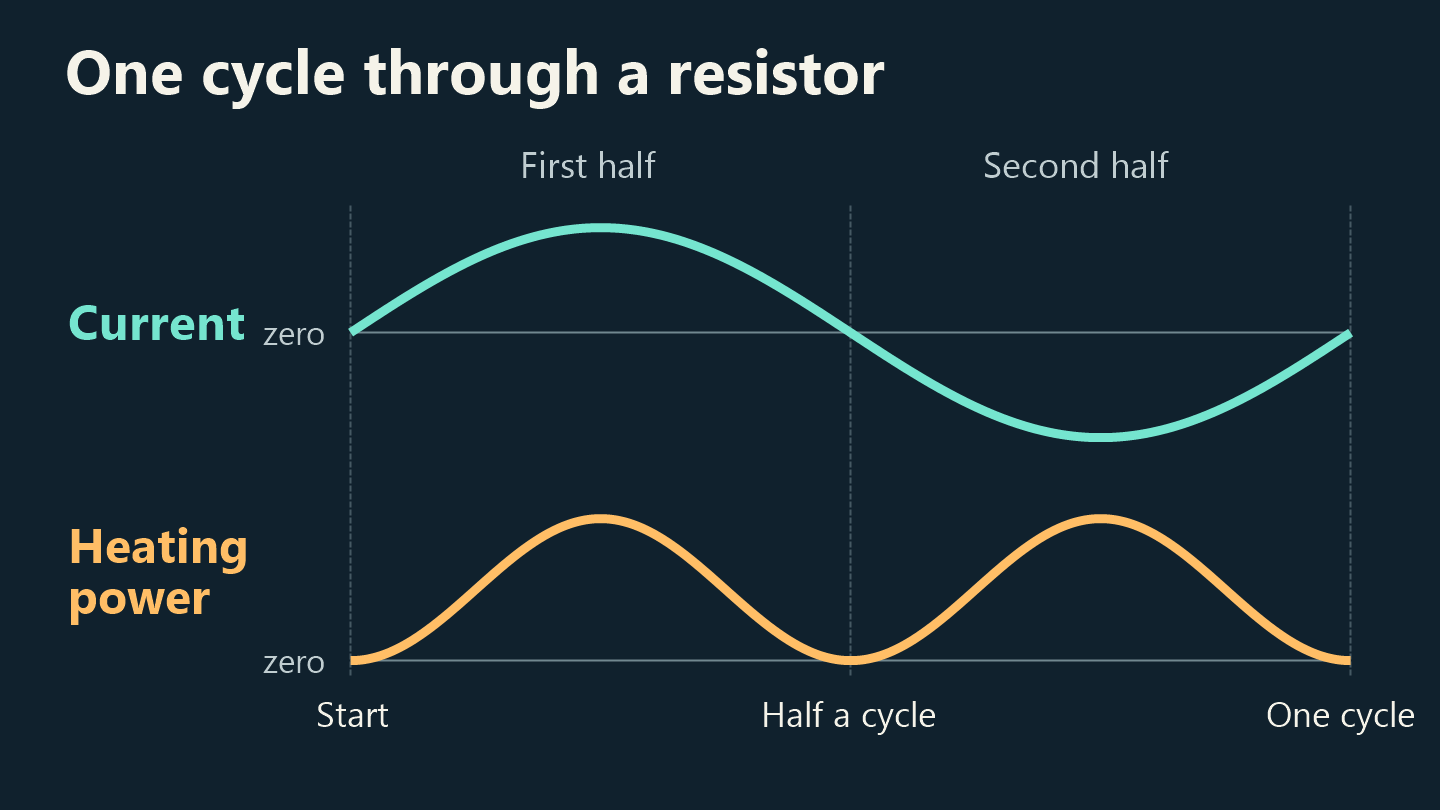
Now picture the lamp on household AC. For half a cycle, electrons in that wire drift one way. As the voltage across the filament falls to zero, their average drift falls to zero, too. Individual electrons are still moving. Then the polarity flips and the electrons drift the other way. The two halves together make one cycle. On the U.S. grid, 60 hertz means 60 full cycles each second. With two changes of direction per cycle, that’s 120 reversals.124
Why does the return trip also make light?
Rub your palms together and pay attention to the return stroke. You get warmth on that stroke, too. The bulb makes heat a different way, but direction matters just as little. As the electric field drives electrons through the filament, they transfer energy to the metal atoms. The atoms vibrate more vigorously. The tungsten gets hot enough to glow. Reverse the push and the electrons still give energy to the metal.12
The filament gets two pulses of heating power per cycle, one on each half. When the current crosses zero, electrical heating drops to zero for an instant. The hot metal takes time to cool. In a lab, researchers measured a filament bulb’s light and electrical input together. The light peaked a little after the power did. That lag helps explain what you see at your desk. The brightness can ripple, but the filament stays hot enough to light your page through each reversal.23
What keeps the push reversing?
Picture falling water turning a wheel. Fix a bar magnet across its axle so the north and south poles take turns sweeping past a coil of wire. As the wheel turns, the magnetic field passing through the coil changes. That change produces a voltage between the ends of the wire. Half a turn later, the push points the other way. The water keeps the wheel turning and supplies the energy.4
How does that energy get to a desk miles away? A transformer uses two coils. Alternating current in the first makes a changing magnetic field, which produces a voltage in the second. If the second coil has more turns than the first, its voltage is higher. A power line can then carry the same power with less current, losing less energy as heat along the way. Near homes, transformers with fewer turns on the output side bring the voltage down again.45
Back at the pencil mark, charge has gone both ways. At your desk, the energy from the turning generator has heated a filament and lit the words on your page.124