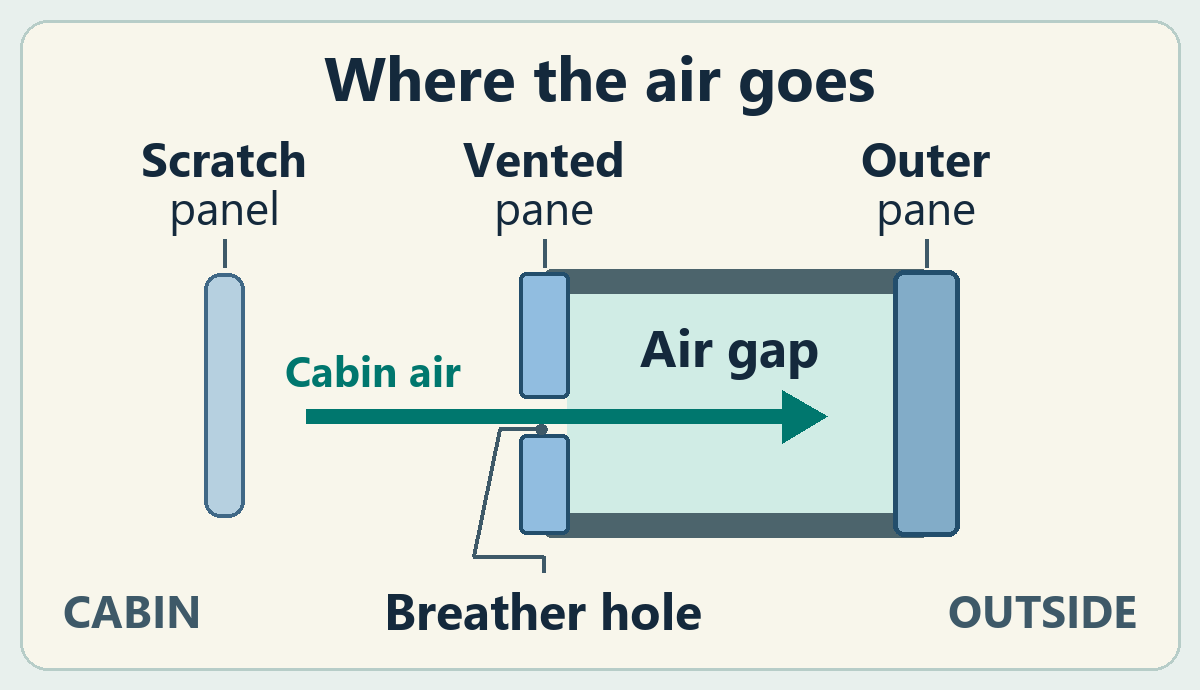
The tiny hole lets cabin air into the gap between the middle and outer panes. In the Airbus A321neo design, that keeps the gap near cabin pressure, so the outer pane takes the usual load. If only the outer pane breaks open, the tiny hole limits how much air leaks out and the middle pane can take over.125
Where does the hole lead?
Start with the clear panel you can touch from your seat. On the Airbus A321neo it’s called the scratch panel because it protects the pane behind it. There are two panes built to hold cabin pressure. The nearer one is in the middle when you count all three layers. That’s the one with the tiny opening, called a breather hole.123
Cabin air can reach the breather hole from the space behind the scratch panel. The hole leads to the narrow gap between the middle and outer panes. A seal runs around the edge of the gap, and the intact outer pane separates the gap from the outside air.12
Why the outer pane takes the push
At cruising altitude, the air pressure in the cabin is higher than outside. When cabin pressure changes, air can pass through the hole in either direction, so the pressure in the gap follows the cabin pressure. Air then pushes almost equally on the two faces of the middle pane. Since those pushes point in opposite directions, they nearly cancel.13
Imagine a cabin pressure of 75 kilopascals and an outside pressure of 25. A kilopascal is a unit of pressure. With the outer pane intact, the gap settles near 75. The middle pane has about 75 on both faces. On the outer pane, there’s about 75 on the gap side and 25 on the outside. That difference of about 50 kilopascals pushes the outer pane outward.13
How can a pane with a hole be the backup?
Now imagine the outer pane breaks open while the middle pane and its seal stay in place. Air in the gap has a much wider path to the outside. At first, it escapes faster than cabin air can replace it through the tiny hole, so the pressure in the gap falls. Cabin air can still leak through the hole, but the small opening limits how much flows out. While the cabin stays pressurized, the air on the cabin side pushes harder than the air in the gap. The rest of the middle pane takes that outward push. Airbus designed it for that job.125
Go back to the same example. If the cabin stays near 75 kilopascals and the gap falls close to the outside pressure of 25, the difference of about 50 kilopascals is now across the middle pane. These are example values. The pressures in flight depend on the damage and on how cabin pressure changes.125
This is the layout Airbus describes for the A321neo. What you see from your seat can vary. Some passenger windows, for example, have an extra panel that dims electronically.14