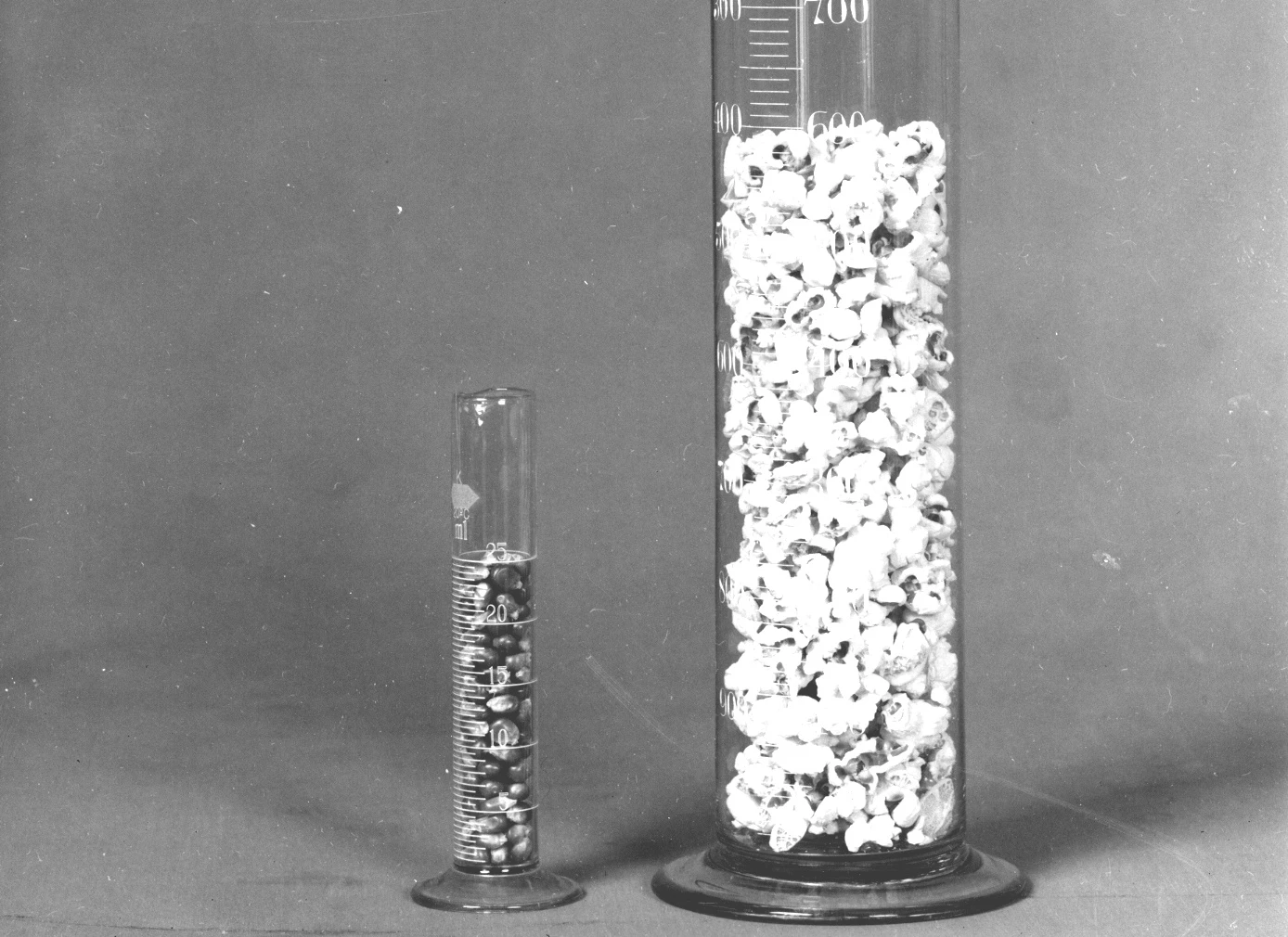
Heat builds pressure until the kernel’s hard hull splits. Steam expands the softened starch into a white flake.12 A kernel can stay hard if it’s too dry, leaks steam, or comes off the heat too soon.234 A bit of starch can push the flake off the pan. In one lab recording, the pop came first. The researchers think escaping steam triggered the sound.3
What the hull holds in
Put one popcorn kernel in a hot pan. Beneath its hard outer coat, called the hull, there’s starch with a little water mixed through it. As the kernel heats, some of that water turns to steam. With the steam held inside the hull, the pressure rises.13
The kernel acts like a little pressure cooker. The higher the pressure, the hotter water has to get to boil. So as steam builds up, much of the water can still be liquid at a temperature that would make it boil in an open pot. Meanwhile, heat and moisture soften the starch. The hull splits when it can no longer hold the pressure inside.123
How the starch puffs up
Follow that same kernel through its first crack. Steam rushes out and the pressure drops. The water that’s still liquid is suddenly above its boiling point at the lower pressure, so some of it turns to steam almost at once.12
Steam takes up much more room than the liquid water it came from. Pockets of steam grow inside the softened starch and stretch it into a foam. The foam sets as it cools. The white flake is the starchy inside of the kernel, puffed up and now on the outside.123
Why some kernels stay hard
Picture two other kernels in the same pan. One starts out too dry. It may run short of water to turn into steam before enough pressure builds, and drier starch is harder to stretch. Researchers tried four kinds of popcorn in hot oil, using the same starting weight for each batch. On average, the leftovers weighed more at ten percent starting moisture than at fourteen percent.24
The second kernel starts with enough water. A crack in its hull can let steam escape early, before there’s enough pressure for a full puff. In one experiment, every deliberately damaged kernel still popped. The researchers measured less expansion in those batches than in the intact ones.25
A kernel may also come off the heat before it gets hot enough. When you find a hard kernel at the bottom of the bowl, its appearance alone can’t tell you whether it started out too dry, leaked steam, or needed more time to heat up.234
What makes the flake jump
Back to the kernel that popped. How did it get airborne? In 2015, researchers Emmanuel Virot and Alexandre Ponomarenko filmed a kernel on a hot plate. In slow motion, a bit of starch pushed out of the opening and pressed against the plate. It squashed and sprang back. Like a tiny leg pushing off the ground, it launched the flake.3
When the pop began
In a separate run, the researchers lined up high-speed video with a microphone recording so they could see what the kernel was doing when the sound began. The first opening was silent on the recording. The microphone caught the pop six milliseconds after a second crack began. The flake was still on the plate. Its bounce came too late to explain the sound.3
The researchers think escaping steam triggered the pop. The sudden release might have made pockets inside the flake vibrate. The timing fits that idea and leaves the exact source of the sound open.3