
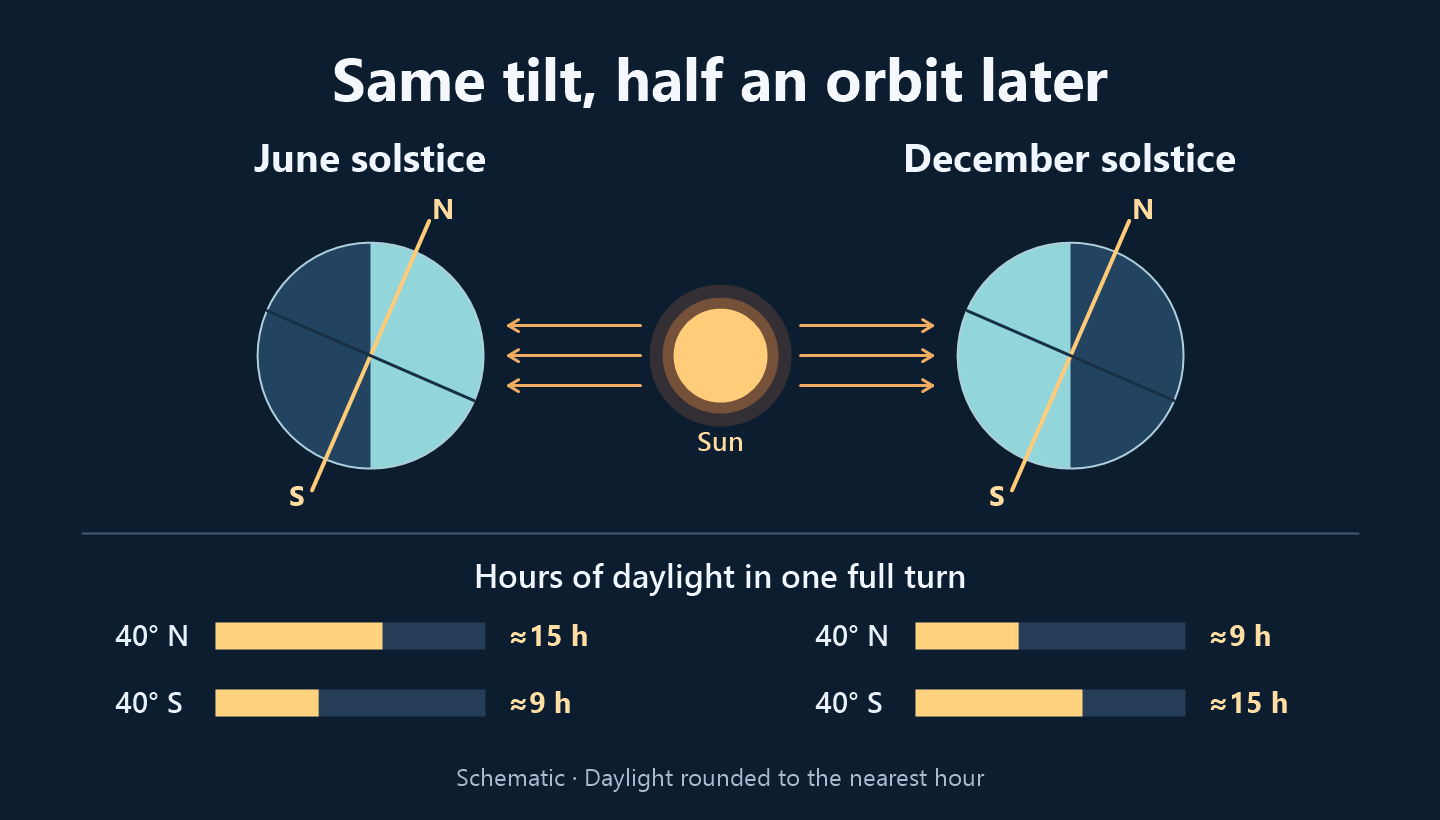
Earth’s tilt changes how long the Sun is up and how directly it shines. As Earth orbits the Sun, each hemisphere takes a turn leaning toward it. In summer at a place like forty degrees north or south, the Sun stays up longer and climbs higher. It has more time to warm the ground, and its light is concentrated on a smaller area. In winter, shorter days and a lower Sun give that same place less solar energy.12
Which dot stays in the light longer?
Let’s aim the lamp at the middle of the globe and tilt the globe about twenty-three and a half degrees from upright. See the line it spins around? That’s its axis. We’ll point its north end toward the lamp. Now pick one of two dots, one at forty degrees north and one at forty degrees south. Before we spin the globe, take a guess. Which dot will spend more of a full turn in the light?12
Watch each dot cross the edge of the shadow. Into the light is sunrise. Back into darkness is sunset. The northern dot travels through a longer stretch of light. Because the globe spins at a steady rate, that longer stretch takes more time to cross. At the June solstice, that works out to roughly fifteen hours of daylight at the northern dot and nine at the southern one.12
Carry the globe halfway around the lamp
Keep your eye on the north end of the axis as we carry the globe around the lamp. It points toward the same corner of the room the whole way. Earth’s axis keeps pointing almost the same way in space as it orbits the Sun. When we reach the other side of the lamp, look where the north end points. It leans away from the light now, and the south end leans toward it.13
Spin it again and follow the same dots. Now the southern dot gets about fifteen hours of daylight and the northern one gets about nine. That’s the December solstice. At the March and September equinoxes, the axis leans sideways relative to the sunlight. Neither end leans toward the Sun, and day and night are nearly equal in length.12
Go back to the northern dot at noon
Return the globe to its June position. Pause the spin when the lamp is highest above the northern dot’s horizon. That’s local noon. In the December setup the lamp is lower in that dot’s sky, even at noon.12
Hold a card flat against the globe at the dot to stand in for the ground. Shine a narrow flashlight beam squarely onto it. You get a tight patch of light. Tip the card so the same beam hits at a slant, and the patch stretches out. The same beam covers more ground, so each bit of ground receives less energy each second.2
Look back at the northern dot in June. Its higher Sun delivers more energy to each patch of ground at midday. Its longer day gives the Sun more hours to deliver that energy. Together those changes help make northern summer warmer. In December the northern dot gets a lower Sun and fewer hours of daylight. The southern dot gets the summer setup instead.12
Earth’s distance from the Sun does change. It’s closest in early January, when the north has winter and the south has summer. Watch what the two dots do on the same globe, at the same distance from the lamp. They trade the longer day and the higher Sun as the globe goes around. Keeping that repeating cycle on roughly the same calendar dates takes a little extra work from February.234