
A steel ship’s hollow hull keeps water out of a space much larger than the steel itself. The ship settles until the water it pushes aside weighs as much as the ship and everything it carries. Adding cargo makes it sit deeper. If enough water floods the hull, the ship can sink.14
What changes when you fold the foil?
Drop a flat piece of aluminum foil into a clear tub of water. If it rests on top, surface tension is helping hold it there. That’s the pull along the water’s surface. Dip one edge with a spoon so water runs over the foil, then pull the spoon away. Watch what happens once the foil is fully underwater. It sinks.123
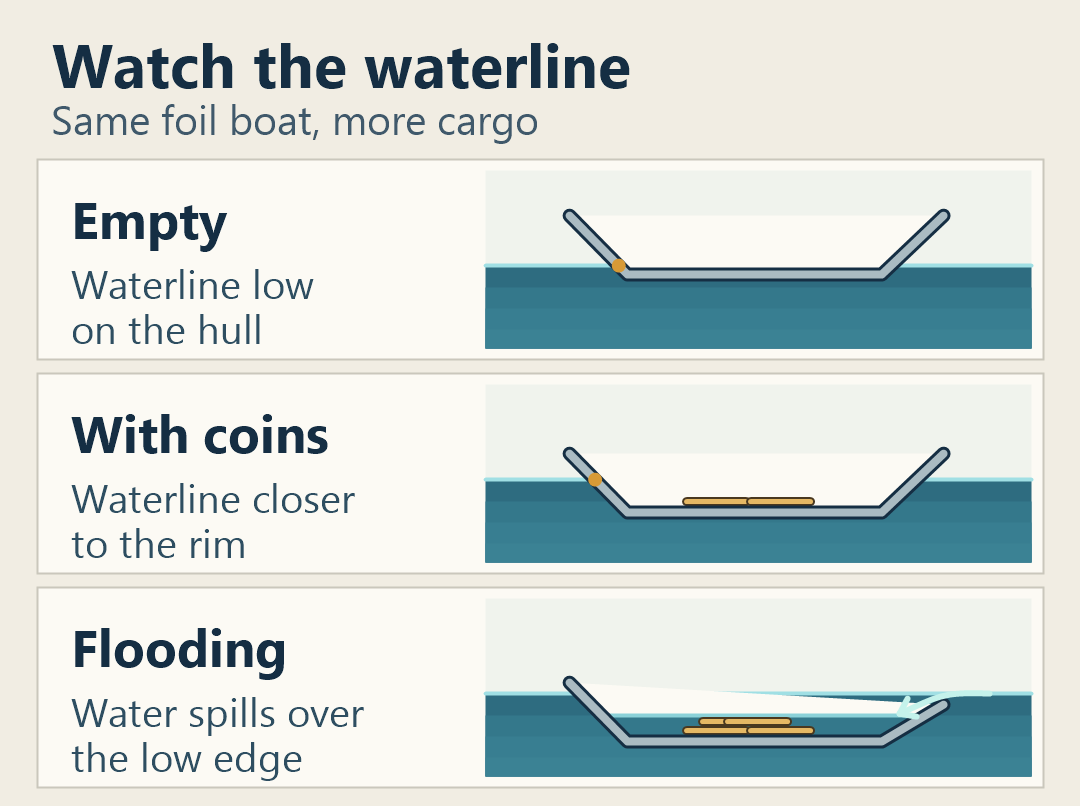
Cut a second piece the same size from the same roll. Fold it into a little tray with a flat bottom and a raised rim. Pinch the corners shut and set the boat in the water. Look through the side of the tub. The bottom dips below the surface, the rim stays above it, and the inside stays dry.2
Where will the waterline go?
Pick a spot on the outside wall where the water meets the foil. Now imagine placing a coin in the middle of the boat. Will the water meet the wall closer to the rim or closer to the bottom? Give yourself a moment to guess. Then set the coin down gently and let the boat settle.12
The boat sits lower. On its wall, the waterline has moved up toward the rim. Below that line, the hull keeps water out of a space the water would otherwise fill. Pushing that water aside is called displacement.1
Water pushes harder at greater depths, so the pushes on the hull add up to an upward force called buoyancy. Archimedes’ principle tells us how big that push is. It equals the weight of the water the hull pushes aside. The coin adds weight, so the boat settles deeper until it pushes aside enough extra water to balance that added weight.1
Try another coin. Keep adding them one at a time near the middle. After each one, let the boat settle and watch the gap between the water and the rim get smaller.12
Watch the first water cross the rim
Keep adding coins until water spills over a low edge. Watch the first bit run inside. The boat drops farther, so more water can spill in. Once the tray fills, the surrounding water occupies the space the hull had kept dry. The foil and the coins still push some water aside, but that water weighs less than the metal. The flooded tray sinks.12
The foil tray has one open space. A real ship can have watertight compartments that limit how far flooding can spread.4
What does a steel ship do with all that space?
Picture a solid piece of steel. Even fully underwater, it can only push aside as much water as would fill the space it takes up. That water weighs less than the steel. Shape the same amount of steel into a wide, hollow hull and it can keep water out of a much larger space. As the ship settles, it can push aside water equal to its full loaded weight while the deck is still above the surface.1
Look where the sea meets the side of a loaded ship. The change you saw with each coin is there on the steel hull. The ship sits deeper under its load, and the waterline is higher on its side.1