
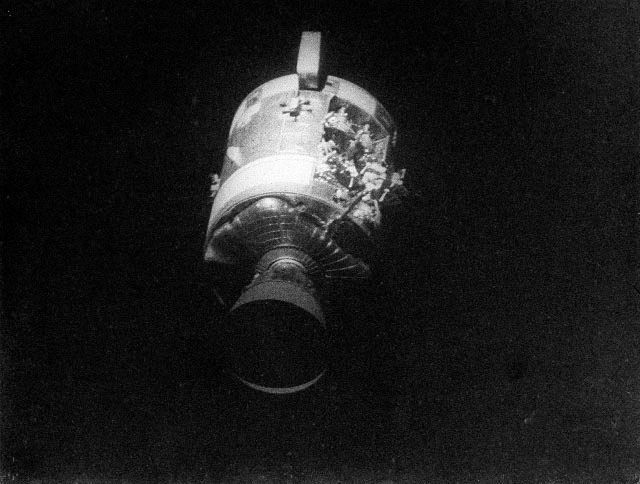
A fire in one of Apollo 13’s two main oxygen tanks cost the spacecraft both supplies. Investigators concluded that damaged fan wiring most likely started the fire. Gas escaped from the failed tank, and the other tank’s oxygen system sprang a leak. Without oxygen, the fuel cells stopped making electricity. The crew used the lunar lander for air, power and the ride around the Moon, then came home in their capsule. On Apollo 14, a third tank sat across the spacecraft. Its valve let the crew keep oxygen for breathing even if the other tanks leaked.1234
Why did an oxygen leak set off an electrical alarm?
On April 13, 1970, Jim Lovell, Jack Swigert and Fred Haise were nearly 56 hours into their flight to the Moon when a bang shook the spacecraft. An alarm warned of low voltage. Minutes later, Lovell looked out the window and saw gas streaming into space. What could that plume outside have to do with the warning light inside?12
Behind the crew’s capsule, in a section called the service module, two tanks held oxygen. Some went to the cabin for breathing. Some went to three fuel cells, devices that combined oxygen with hydrogen to make electricity and water. Tank two lost its oxygen in a rush. The pressure in tank one kept falling, too. All three fuel cells depended on that same dwindling supply. The crew still had batteries, but they would need them to get back through Earth’s atmosphere.12
What happened to tank two before launch?
Weeks before launch, technicians had trouble emptying tank two after a test. They ran its heaters to boil off the oxygen. A pair of switches should have cut the heat when the assembly grew too hot. In tests afterward, investigators found that the 65-volt ground supply, more than double the switches’ 30-volt rating, could weld the switch contacts together. A switch stuck closed keeps the current flowing.1
NASA’s review board pieced together what most likely happened next. The heaters stayed on long enough to damage insulation on wires leading to a fan inside the tank. That fan stirred the oxygen during flight. When the crew switched it on, electricity likely arced across damaged wiring and ignited insulation. The oxygen fed the fire. Pressure rose, the tank assembly gave way, and the escaping gas blew a panel off the service module. The same event left the first tank’s oxygen system leaking.1
How could a Moon lander bring three people home?
The Moon landing was off. Still attached to the capsule, Odyssey, was Aquarius, the lander built to take two people down to the Moon. It had its own oxygen, batteries and engine. The crew powered down Odyssey to save its batteries and turned on Aquarius. They fired the lander’s descent engine, the one meant to lower it to the lunar surface. That burn put the joined spacecraft on a path that curved around the Moon and back toward Earth. After they rounded the far side, another burn shortened the trip.2
Now three people were breathing in a cabin built for two. Each breath out added carbon dioxide, and the lander’s filters could only take up so much. There were spare filters in Odyssey, but they didn’t fit the lander’s equipment. Engineers in Houston tested a way to connect the two systems using things the crew already had. With a plastic bag, tape and a suit hose, the astronauts could draw cabin air through the spare filters.2
Near Earth, the crew powered Odyssey back up. They released the damaged service module and photographed the gap where its side panel had been. Then they let Aquarius go. The lander had carried them around the Moon. Odyssey’s heat shield protected them as they plunged back into the atmosphere. All three splashed down in the Pacific on April 17, 1970.25
Where would you put the next oxygen tank?
Picture the missing panel again. Both of Apollo 13’s tanks had sat behind it on the same shelf. If you had room to add a third tank to the next spacecraft, where would you put it?15
On Apollo 14, engineers put the third tank on the opposite side of the service module. They also gave the crew a valve that could cut that tank off from the other two tanks and the fuel cells, while still feeding oxygen to the cabin. That gave the reserve two kinds of protection. A blast beside the original tanks would have farther to reach. And if their plumbing sprang a leak, closing the valve could keep the crew’s breathing oxygen from escaping through it.34