
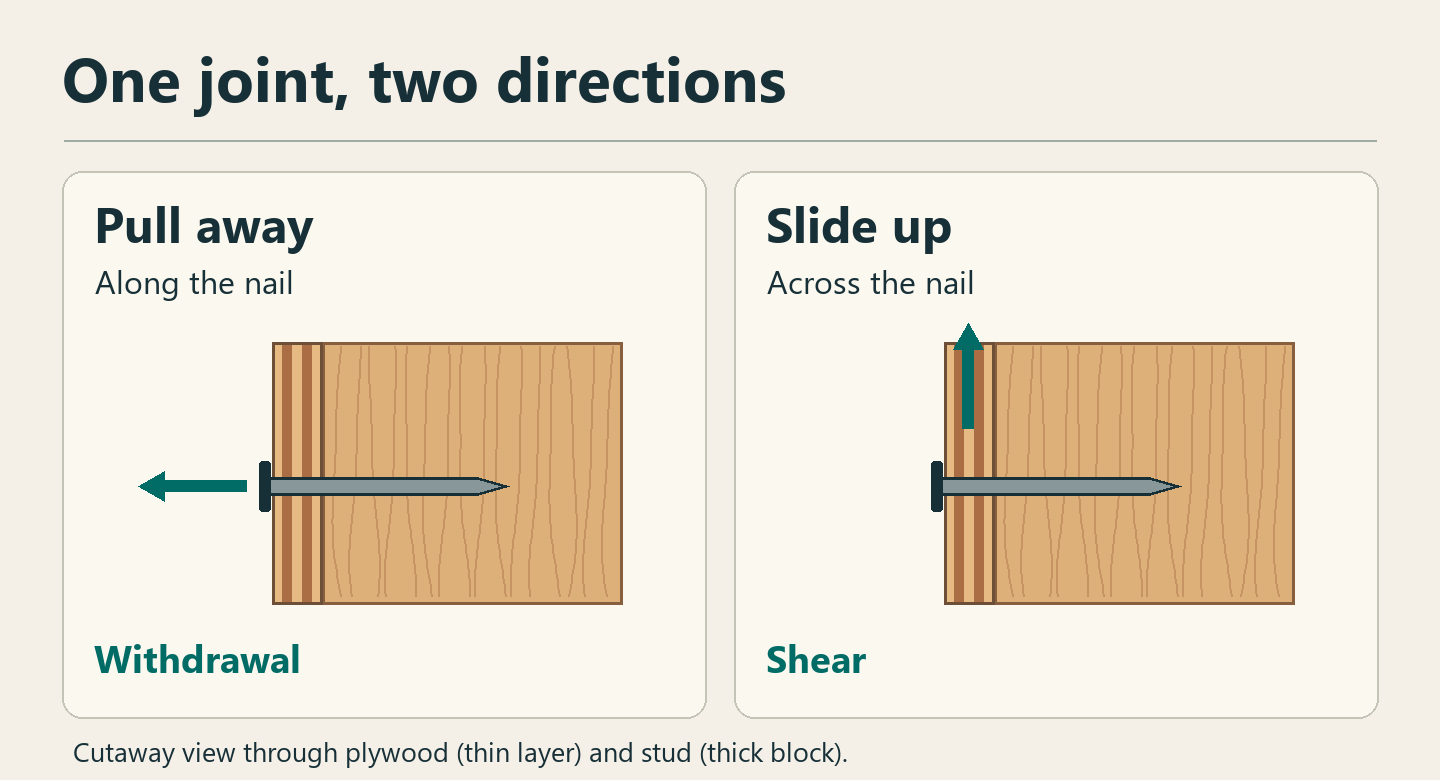
Nails are quick and economical to install, and a properly nailed joint can resist pieces of wood sliding past each other. Screw threads help when a force tries to pull the fastener straight out. For many everyday wood-framing joints, the U.S. model residential code already specifies the size, number and placement of nails. Structural screws can also work when their evaluation covers the connection.1234
Which way is the plywood moving?
Picture a sheet of plywood flat against a wall stud, one of the upright pieces of lumber in a wood-frame house. A nail passes through the plywood into the stud. Imagine pulling the sheet straight toward you. The sheet bears against the nail head. If the nail comes with it, it moves back along the path it took going in. Engineers call that withdrawal. A screw’s threads bite into the wood, so pulling it straight out means forcing those threads past the wood that holds them.1
Now put the sheet back. Keep it flat against the stud and try to slide it up. The plywood presses on one side of the nail shaft, and the wood in the stud presses on the other. Watch the nail where the two pieces meet. It carries the push from the plywood into the stud. A push across the shaft is a lateral load. The two pieces pushing past each other put the nail in shear.1
What happens when wind pushes a wall sideways?
Imagine nudging the top of a rectangular picture frame sideways until the corners skew. Wind can put the same sort of sideways load on a wall, along the length of the wall. A sheet of plywood fastened across the studs helps keep the frame square. As the studs and plywood try to slide past each other, the row of nails along the panel edge transfers the load between them.12
Under a large enough sideways load, the wood around a nail can dent and the steel shaft can bend while it still carries load. A claw hammer tests something different. It pulls an individual nail along its length, while a sideways push on the wall loads the row of nails across their shafts.12
Why does the crew keep reaching for the nail gun?
Step back from the plywood and look at the bare frame. The studs meet horizontal boards called plates at the top and bottom of the wall. The U.S. model residential code lists several nailing options for that joint. Its fastening schedule specifies which nails to use, how many and where they go. The diameter matters as well as the length because the wood presses against the shaft and the shaft has to resist bending.13
Multiply that joint by all the studs in a house, then add the rows of fasteners in the plywood. A framing nailer drives a nail in one stroke and feeds the next one into place. A driver turns each screw until it seats. That speed helps keep installation costs down. Once the specified nails meet the joint’s load requirements, extra pullout grip by itself gives a crew little reason to switch.235
When does a screw earn its place?
A screw can carry a sideways load, too. Picture two screws of the same length. One is sold for hanging drywall. The other is a structural wood screw with published load ratings. Both have threads. For the framing joint, what matters is how much load that specific screw can carry in the direction the joint will be loaded.14
One evaluation lists specific structural screws that can replace particular framing nails. It accounts for the diameter of the steel underneath the threads and how much bending the screw can resist. That evaluation covers certain connections between pieces of framing. A braced plywood wall like the one we started with needs its own evidence. For a particular house, the plans, locally adopted code and fastener rating determine which fastener goes where.34